Building Your First AI Strategy: A 90-Day Roadmap for SMBs
Artificial intelligence is not just for enterprise companies with big technology budgets. AI ML development company is already being leveraged by small and medium-sized businesses to automate repetitive tasks, enhance customer response rates, minimize manual reporting, and facilitate quicker decision-making.
A well-defined 90-day roadmap using the appropriate AI/ML development services or AI/ML consulting servicescan prevent you from falling into that trap by prioritizing measurable business outcomes.
Importance of Having an AI Strategy
AI tools are readily available for purchase. Creating a usable AI operation is a lot more difficult. Teams typically test too many platforms simultaneously, duplicate efforts, or automate inefficient processes without a strategy. When there is no clear ownership or measurable target, businesses implementing artificial intelligence and machine learning solutionsoften find themselves in a struggle.
Your AI strategy needs to address:
- What is the business problem that needs to be addressed?
- What is the most time-consuming process for employees?
- What will be the outcome that will demonstrate the success of AI investments?
The most common areas where most SMBs begin are with customer support, internal reporting, lead qualification, scheduling, document management, or marketing workflows, as well as investing in custom AI/ML solutions and/or hiring AI developers. These areas deliver visible improvements in a short time with no need for complex infrastructure.
The first 90 days are about building one successful implementation and an AI implementation roadmap for SMBs that builds confidence throughout the business.
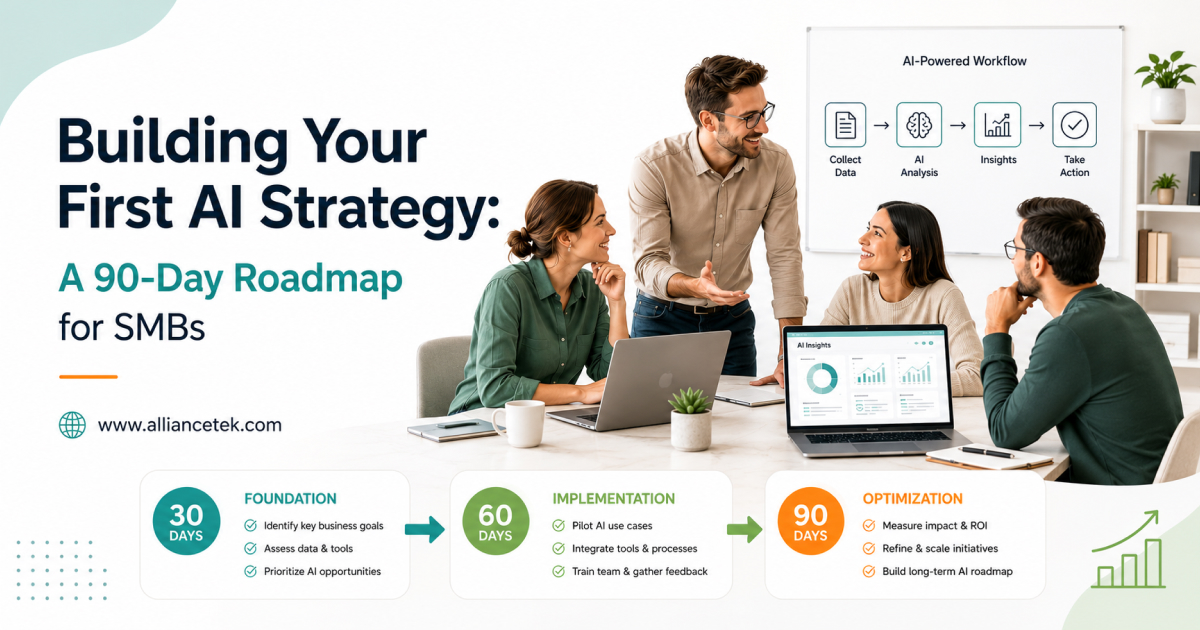
Days 1-30: Review Operations and Look for Short-term Gains
The first month should be spent on assessment. First, look at repetitive workflows within departments. Ask managers what the biggest time wasters are for employees each week. This evaluation is typically done before assigning technical resources to a business that is planning to hire a dedicated AI ML developer team.
Common examples include:
- Manual invoice processing
- Repetitive customer emails
- CRM updates
- Data entry
- Meeting summaries
- Reporting consolidation
- Support ticket classification
After you have identified operational bottlenecks, prioritize tasks with three filters:
- High repetition
- Low implementation complexity
- Clear measurable outcome
This should also involve a simple audit of your current systems. Many SMBs already use platforms withbuilt-in AI readiness assessment for SMBs, but never activate them. After 30 days, establish success criteria for your pilot project.
These may include:
- The number of hours that each employee saves.
- Quick response to customers.
- Reduce manual processing workload.
- Reduced reporting delays.
- Improved lead conversion rates.
If you don’t have baseline measurements, you won’t be able to calculate ROI later. For some SMBs, the initial reason for hiring top freelance AI ML developers is to test out the technology in small-scale projects, thereby minimizing the risk of a substantial investment.
Days 31-60: Start a Targeted Pilot Project
Execution starts in the second month. A focused pilot minimizes risk and provides teams with learning without disruption. SMBS should select a small team of employees willing to experiment, as they tend to be more successful in their endeavors. In this stage, numerous businesses hire AI/ML developersto handle workflow automation and system integration.
There should be four operational priorities in this stage.
1. Build Clear Ownership
Accountability is a crucial component of any AI initiative. Designate one internal owner to take responsibility for:
- Tool coordination
- Team feedback
- Performance tracking
- Vendor communication
- Security review
It’s also important for organizations to establish reporting lines from the outset to prevent ownership from becoming spread across departments when hiring an artificial intelligence engineer.
2. Train employees early
Resistance is typically not a result of technology, but rather uncertainty. Staff should be aware of the role AI plays in their work, not to replace them.
Training should remain practical. Demonstrate to teams how AI can help eliminate repetitive tasks, boost accuracy, or speed up turnaround times. Don’t have too technical of workshops in the first phase. Early investment in an AI adoption strategy can lead to higher adoption rates later on.
3. Create governance guidelines
Basic AI governance is essential for all SMBs before scaling up AI use.
The first policies you should have are:
- Which tools can employees use
- How customer data is handled
- Which information cannot be uploaded into AI systems
- Approval processes for AI-generated content
- Access permissions
4. Document the workflow
Record successful processes as the pilot proceeds.
Create brief internal explanations that explain:
- When employees should use AI
- Which prompts yield reliable results?
- How outputs are reviewed
- What manual checks are still required?
This documentation is essential when adoption moves beyond teams. The internal workflows that businesses use when they hire artificial intelligence engineers are typically used to standardize future deployments across departments.
Days 61-90: Assess Outcomes and Plan for Scaling
The last month is dedicated to optimization and business alignment. The focus at this stage is on demonstrating operational value. Check your original success measures and compare them to current performance.
Assess results, including:
- Time savings
- Employee productivity
- Customer response improvements
- Minimization of manual errors
- Faster reporting cycles
This is also the time when integration is important. Many SMBs start by integrating AI capabilities into their current tools, such as CRM, helpdesk, accounting, or internal knowledge bases. Such integrations, where companies hire AI/ML programmers, streamline processes and eliminate the need to work across disparate tools.
Too fast growth can lead to confusion and inconsistent adoption. Rather, look at the next highest impact process and transfer the lessons learned from the first pilot.
A successful 90-day AI transformation plan for mid-sized businesses usually produces three long-term benefits:
- Employees feel more at ease with AI. Staff feel more comfortable using AI.
- Leadership achieves measurable ROI visibility.
- The business creates a repeatable process for implementation.
Common Errors SMBs Make
There are a few common pitfalls in the adoption of AI that are seen across small and mid-sized businesses.
- The goal of operational AI integration for small businesses is to address operational issues. Companies that follow trends without understanding what their actual workflow problems are are unlikely to achieve any tangible benefits.
- Testing several tools simultaneously leads to confusion, inconsistent use, and security issues. Early adoption is the best time for focused adoption.
- Clean and accessible business data is the foundation of AI systems. Inaccuracies in CRM, incomplete records, and inconsistent reporting diminish the accuracy of AI.
Summing up
A clear 90-day plan prevents businesses from experimenting in a haphazard way and allows them to gradually adopt AI. The companies that are early successes are not always the ones that are spending the most money on AI. They are the ones who are directly linking AI initiatives to business goals, employee workflows, and measurable operational improvements. For more information, contact the developers at AllianceTek.

Recommended For You
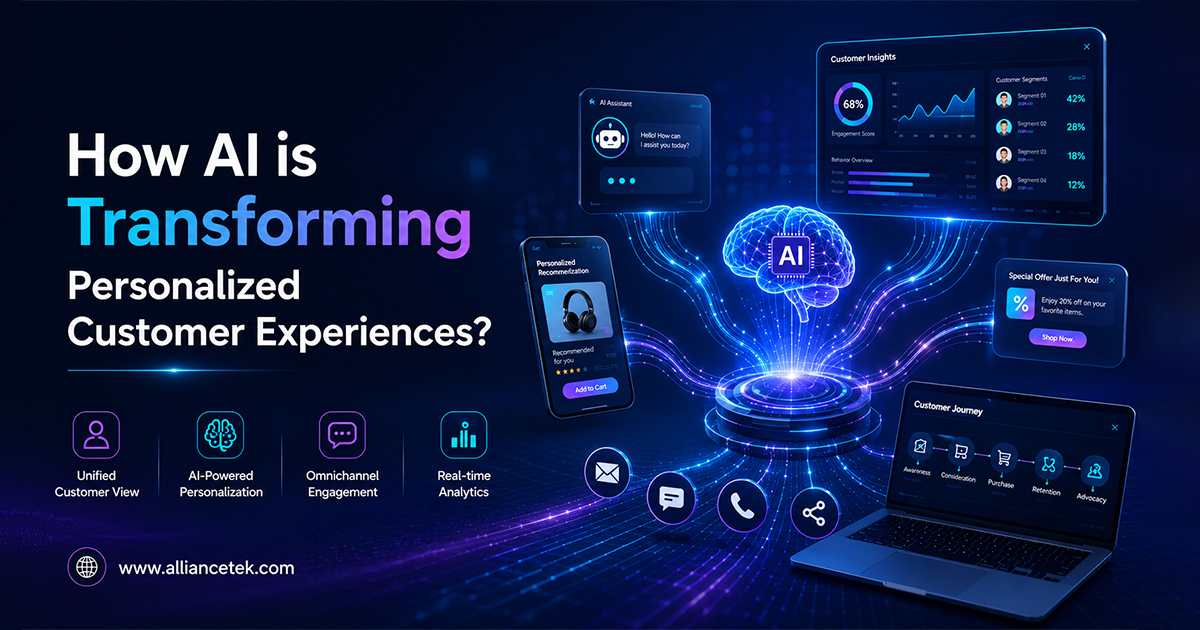
Using AI to deliver personalised customer experiences at scale.Harnessing AI for personalized customer experiences on a large scale. The expectations
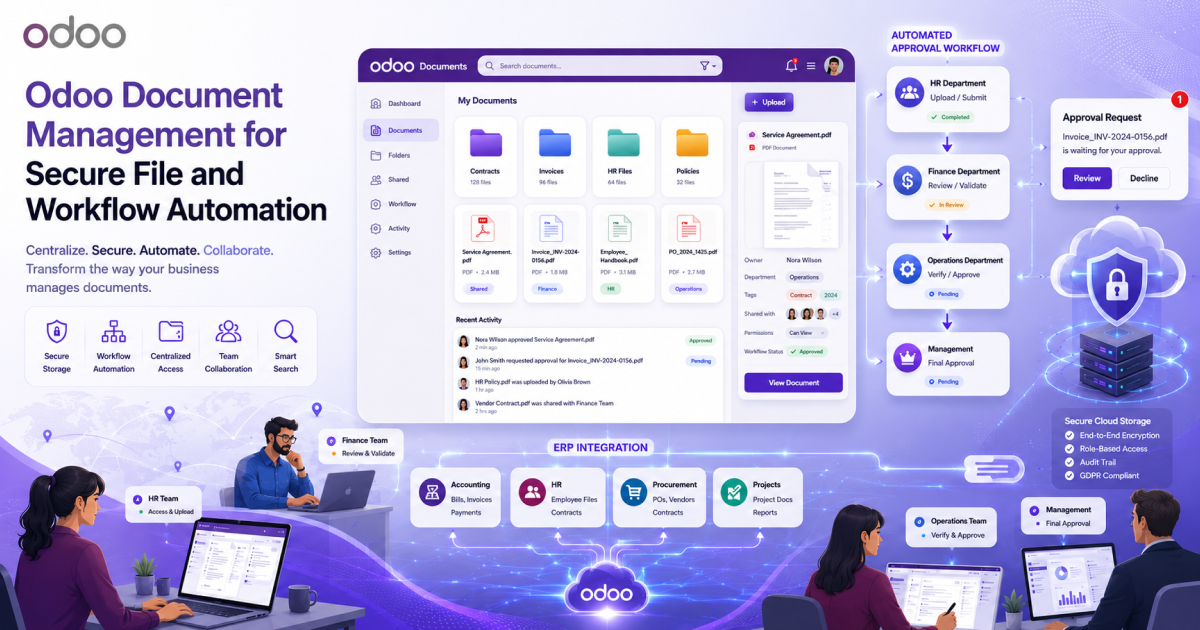
In every department within a business, documents need to flow seamlessly between people, systems, and approvals. Contracts transition from legal

The business world today requires an ERP system that is scalable, adaptable, and quick. The customization of traditional ERP is