How AI is Transforming Personalized Customer Experiences?
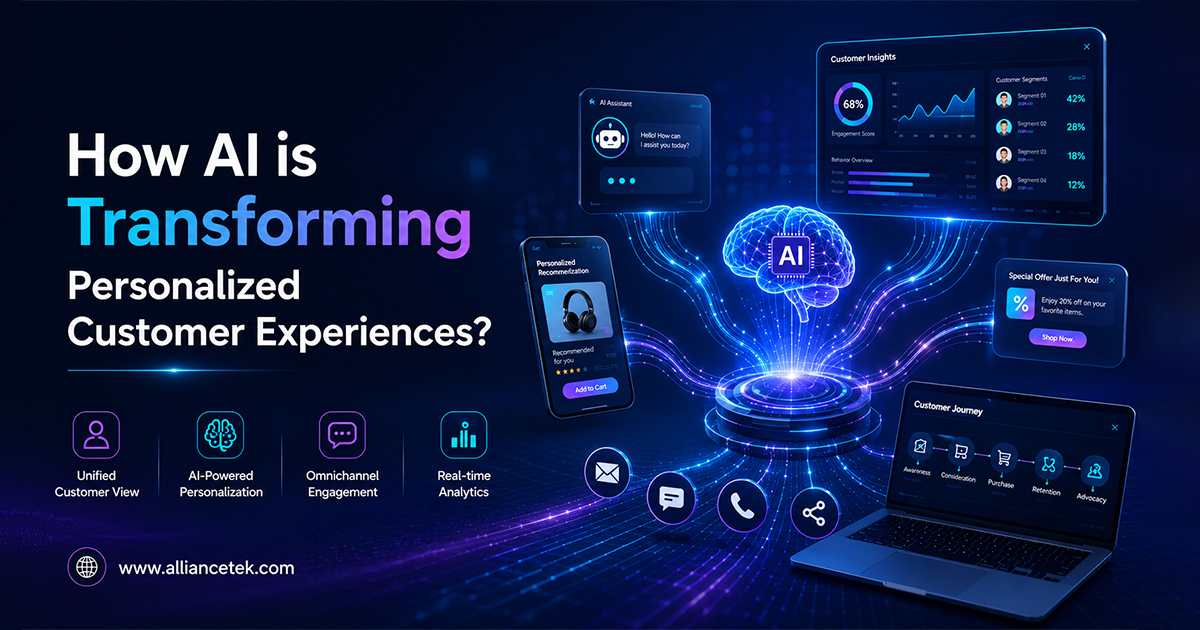
Using AI to deliver personalised customer experiences at scale.Harnessing AI for personalized customer experiences on a large scale. The expectations of customers have been transformed in the past couple of years. People don’t respond well to generic interactions, general recommendations, or one-size-fits-all communication.
Businesses are now using AI for personalized omnichannel customer journeys to gain insights into customer behavior, decipher preferences, and offer real-time personalized interactions. A lot of organizations collaborate with an AI ML development company to create systems that can manage personalization for a big customer base.
This is possible at scale with the help of artificial intelligence. This is being provided more and more via enterprise-grade AI/ML development services focused on enhancing engagement and retention.
Why Traditional Personalization No Longer Works?
Traditional AI-driven customer personalization was based on a limited number of pre-defined customer segments and manual rule-setting. This works in smaller settings, but it’s not enough to meet today’s customers’ expectations.
Static segmentation has several drawbacks:
- Delayed Responses: Customer preferences are constantly changing, and manual systems can’t keep up.
- Traditional systems: Systems that are traditional are based on basic demographic data, not behavioral insights.
- Disconnected Systems: Customers interact with the business via various channels, and there is no integration, leading to disjointed experiences.
- Scalability Issues: Managing personalization manually becomes difficult as the amount of customer data increases.
To overcome these challenges, companies are seeking AI/ML consulting servicesto help them put intelligent personalization into action for their customer experience initiatives.
How AI is Customizing Customer Experiences
The key to AI personalization is its ability to continuously gather, analyze, and tailor interactions based on customer data.
1. Data Collection
AI systems collect data from various interactions, such as browsing history, transactions, customer service interactions, and engagement metrics. This is the basis for better artificial intelligence and machine learning solutions that are customer intelligence-driven.
2. Behavior Analysis
AI can understand customer interactions with products, content, and services. It’s not only about what has been purchased in the past, but also about patterns that indicate preferences and intentions. This can be improved with predictive customer behaviour analytics, which allows businesses to anticipate customer behaviour before it occurs.
3. Real-Time Adaptation
AI-powered customer engagement platforms dynamically adapt recommendations, messaging, and experiences in real-time, according to customer activity. Custom AI/ML solutions are frequently used to enable such adaptive personalization on digital channels.
4. Recommendation Engines
AI recommendation systems are used to suggest products, services, or content to customers based on their interests. Many businesses are hire AI/ML developers to create personalized recommendation systems that resonate with their customer journey.
Personalization Across Multiple Channels
Customer interactions no longer have to be confined to one platform. Users navigate from site to app, social media to email to support and back again. AI can then help to stitch these touchpoints together to form a seamless customer journey across all channels.
- Web Experiences: Websites dynamically change content, product recommendations, and messages based on customer behavior.
- Email Campaigns: AI optimizes subject lines, content, and timing based on engagement patterns.
- Customer Support: AI systems can help customer support teams to access customer history and give timely and relevant responses.
- Mobile Applications: Apps tailor notifications, recommendations and interfaces to usage patterns.
To ensure consistency in personalization across channels, many companies hire a dedicated AI ML developer team.
The Impact of AI on Customer Engagement
AI personalization enhances engagement by providing more relevant and timely interactions.
1. Faster Recommendations
AI systems process customer data in real-time and provide suggestions during the customer’s usage. Companies frequently hire the best Freelance AI ML developers to enhance the accuracy and responsiveness of their recommendations.
2. More Relevant Content
AI determines what customers are likely to interact with and adapts content to suit. This enhances the quality of interaction and decreases irrelevant communication.
3. Better Timing
AI determines the best time to reach out to customers with messages or offers. These engagement models are optimized by many organizations by hiring Remote AI ML Developers across their global customer base.
4. Dynamic Experiences
Customer experiences are not static, but are dynamic and change in real-time based on behavior. This capability is now being offered by real-time customer experience optimization platforms that continuously adapt throughout the customer experience.
Understanding the Technology Powering AI Personalization
AI personalization is built on several technologies that collaborate to analyze customer data and provide personalized experiences.
- Machine Learning Models: Machine learning algorithms can detect behavioral patterns and anticipate customer preferences. These models are often customized for specific industries and user segments by hiring AI/ML developer
- Natural Language Processing: NLP helps AI systems to comprehend customer interactions, feedback, and conversations.
- Recommendation Systems: Recommendation engines take into account customer behaviour and make relevant recommendations based on the overall pattern. To cost-effectively scale these systems, many businesses hire offshore AI ML developers.
- Automation Platforms: Automation platforms handle messaging, campaigns and customer interactions across channels.
Advantages Beyond Customer Satisfaction
AI personalization enhances engagement and more. It also generates measurable business results.
- Better Retention: Relevant and personalized experiences keep customers engaged.
- Improved Conversion Rates: Personalized suggestions boost the chances of purchases and interactions.
- Enhanced Efficiency: Automation minimizes manual workload in campaign management and customer segmentation.
- Enhanced Customer Insights: AI-driven customer engagement platforms offer more comprehensive insights into customer behavior and preferences.
For these goals, numerous organizations hire the best AI/ML developers that specialize in personalization systems and customer analytics.
Conclusion
AI personalization is revolutionizing customer interactions in business. Organizations can now tailor interactions in real-time for different behaviors, preferences and intent, instead of delivering a one-size-fits-all experience for a broad customer base.
By using machine learning, automation, and predictive insights, businesses can create faster, more relevant, and more consistent customer experiences at scale. This change enables businesses to enhance customer engagement and foster long-term customer connections. AI-driven personalization will be a key component of customer experience strategies in the future, as customer expectations continue to shift.

Lareal Young is a legal professional committed to making the law more accessible to the public. With deep knowledge of legislation and legal systems, she provides clear, insightful commentary on legal developments and public rights, helping individuals understand and navigate the complexities of everyday legal matters.
Recommended For You
Artificial intelligence is not just for enterprise companies with big technology budgets. AI ML development company is already being leveraged
In every department within a business, documents need to flow seamlessly between people, systems, and approvals. Contracts transition from legal
The business world today requires an ERP system that is scalable, adaptable, and quick. The customization of traditional ERP is