Serum Alkaline Phosphatase (ALP): What the Test Measures and What Results May Mean
What Is Serum Alkaline Phosphatase?
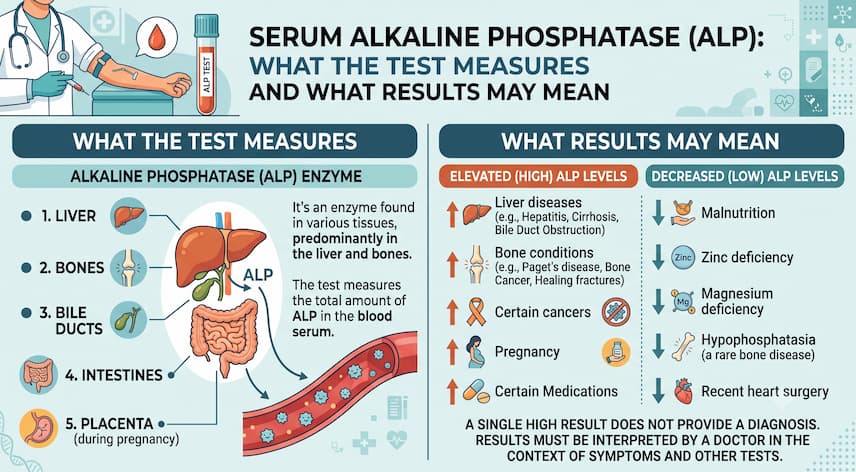
Alkaline phosphatase is an enzyme, a type of protein that helps speed up specific chemical reactions in the body. ALP is present in several tissues, most notably the liver, the cells lining the bile ducts, and bone-forming cells. Smaller amounts are also found in the intestines, kidneys, and, during pregnancy, the placenta.
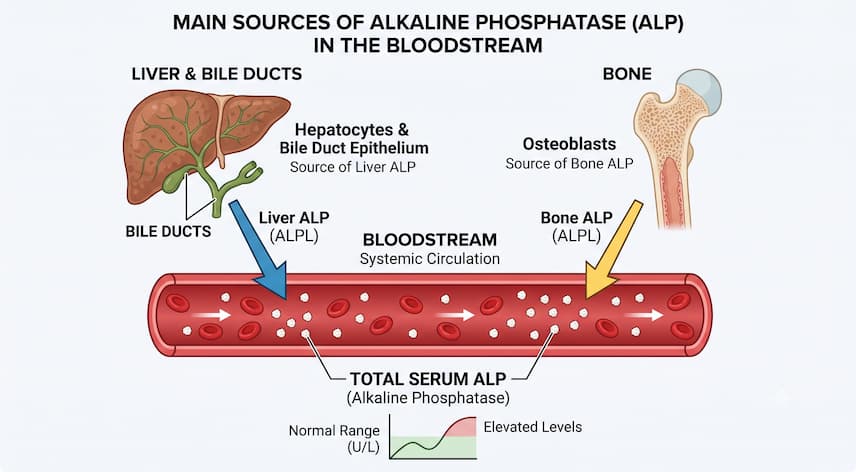
As these tissues carry out their normal functions or undergo change, small amounts of ALP are released into the bloodstream. “Serum” refers to the liquid portion of blood that remains after clotting factors and blood cells are removed. Measuring ALP in serum gives clinicians a snapshot of enzyme activity circulating in the blood at the time the sample was drawn.
What Is the Alk Phos Blood Test?
The alk phos blood test, also called an ALP laboratory test or ALP blood work, is a standard blood draw that measures the concentration of alkaline phosphatase in serum. It’s often included as part of a broader laboratory panel, such as a comprehensive metabolic panel or liver function panel, rather than ordered entirely on its own.
The test itself simply reports a numerical value for ALP activity in the blood. It does not, by itself, identify a specific disease or condition. The result needs to be interpreted alongside other laboratory findings, a person’s symptoms, and their overall medical history by an appropriate healthcare professional.
Why Is an ALP Test Ordered?
ALP is commonly included in laboratory evaluation for several general reasons, including:
- Evaluating abnormal liver-related laboratory findings noted on other tests
- Assessing possible involvement of the bile ducts
- Evaluating bone-related concerns or findings
- As part of routine or broader laboratory panels when clinically appropriate
- Following up on previously abnormal laboratory results
The specific reason ALP is ordered varies by individual circumstances, and a healthcare professional determines what testing is appropriate for a given situation.
Where Does ALP Come From?
Liver
In the liver, ALP is closely associated with the bile ducts, the small tubes that carry bile from the liver to the digestive system. When bile flow is disrupted or bile ducts are affected, a pattern sometimes described as cholestatic, ALP levels can rise as more of the enzyme is released into circulation.
Bone
ALP is also produced by osteoblasts, the cells responsible for building new bone tissue. Because of this, ALP levels can reflect bone-formation activity. This is one reason ALP levels are often naturally higher during periods of active bone growth, such as childhood and adolescence.
Other Sources
Smaller amounts of ALP originate from the intestines and kidneys, and during pregnancy, the placenta contributes additional ALP to the maternal bloodstream. These sources are typically minor contributors compared to the liver and bone under most circumstances.
ALP Normal Range
There is no single universal number that defines a “normal” ALP result for everyone. Laboratory reference intervals, the range a specific lab uses to flag results as within or outside expected values, can differ based on:
- The laboratory performing the test and its specific testing method
- Age, since children and adolescents often have higher expected ALP values due to bone growth
- Sex, as reference intervals can differ between adult men and women
- Life stage, including pregnancy, which can raise ALP levels
- The particular assay or instrumentation used by the lab
Because of this variability, the most relevant reference interval for interpreting your result is the one printed on your specific laboratory report, not a number found elsewhere online. A result should always be evaluated against that report’s reference range and discussed with a healthcare professional if it falls outside expected values.
What Does High Alkaline Phosphatase Mean?
An ALP result above the laboratory’s reference interval means more of the enzyme is circulating in the blood than is typically expected. On its own, this finding does not identify a specific cause. Elevated ALP can originate from the liver, bile ducts, bone, or, in some circumstances, reflect a normal physiological state rather than a medical problem.
Because ALP can rise for many different reasons, an elevated result is generally interpreted alongside other laboratory findings, a person’s symptoms, and their overall health history, rather than being read as a stand-alone diagnosis.
Common Reasons ALP May Be High
Elevated ALP is often grouped into broad categories based on where the extra enzyme is likely originating:
- Liver or bile duct–related processes, where disruption to normal bile flow can increase circulating ALP
- Increased bone turnover, which can occur with various bone-related processes or conditions
- Normal growth in children and adolescents, when bone formation is naturally active
- Pregnancy-related changes, particularly in later stages, due to placental contribution
- Other physiological or medical circumstances, which a healthcare professional can help evaluate based on individual context
This is a general framework for understanding possible categories, not a diagnostic checklist. Determining the actual cause requires clinical evaluation.
Isolated Raised ALP
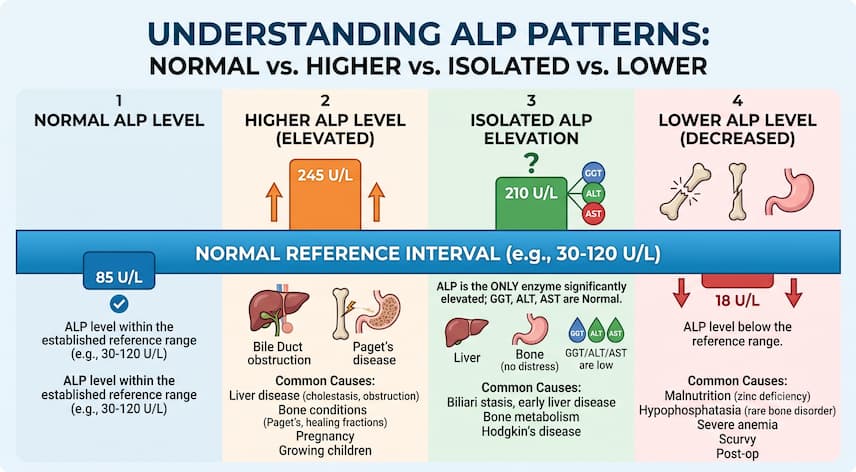
“Isolated” ALP elevation refers to a situation where ALP is above the reference interval while other related laboratory results, such as liver enzymes or bilirubin, remain within their expected ranges. This pattern raises a specific clinical question: is the extra ALP coming from the liver, or from a non-hepatic source like bone?
Because ALP is produced by more than one type of tissue, an isolated elevation doesn’t automatically point to the liver. Clinicians often consider additional testing to help narrow down the likely source. An isolated raised ALP result is not, by itself, a diagnosis, and it does not automatically indicate a serious condition.
How Can the Source of Elevated ALP Be Investigated?
When ALP is elevated, healthcare professionals may consider additional laboratory tests to help clarify where the extra enzyme is likely originating, including:
- GGT (gamma-glutamyl transferase) — often used alongside ALP to help assess whether elevated ALP is more likely liver-related, since GGT is less commonly affected by bone conditions
- AST and ALT — liver enzymes that can provide additional context about liver cell activity
- Bilirubin — can help assess bile flow and liver function more broadly
- Calcium and phosphate — relevant when bone-related causes are being considered
- Vitamin D — sometimes evaluated alongside calcium and phosphate in the context of bone health
- Other tests, selected based on an individual’s specific presentation and history
These tests work together to build a clearer picture. This overview explains their general purpose and is not intended as a step-by-step diagnostic pathway for self-interpretation.
Alkaline Phosphatase Low
A low ALP result, sometimes described as decreased alk phos, means the enzyme level falls below the laboratory’s reference interval. Low ALP has several possible associations, and, like elevated results, it should be interpreted within the context of a person’s overall clinical picture rather than assumed to point to one specific cause.
A low result does not, on its own, confirm any particular condition. A healthcare professional can help determine whether further evaluation is appropriate based on the full laboratory panel and individual history.
What Are the Symptoms of High Alkaline Phosphatase?
Alkaline phosphatase itself generally does not cause symptoms. It’s an enzyme, not a condition, so an elevated level is a laboratory finding rather than something a person typically feels directly.
When symptoms are present, they usually relate to the underlying process associated with the abnormal ALP result, rather than to the enzyme itself. For example, liver or bile-duct-related conditions might involve symptoms like fatigue or digestive discomfort, while bone-related conditions could involve different symptoms entirely, depending on the specific cause. It’s also common for someone to have an ALP result outside the reference interval without noticing any symptoms at all, which is part of why routine laboratory testing can identify findings a person wasn’t otherwise aware of.
High vs. Low ALP
| Result Pattern | General Meaning | Possible Context | Important Consideration |
|---|---|---|---|
| Higher ALP | Above laboratory reference interval | Liver, bile duct, bone, or physiological factors like growth or pregnancy | Source and other lab results matter for interpretation |
| Lower ALP | Below laboratory reference interval | Multiple possible associations | Clinical context matters |
| Isolated higher ALP | ALP elevated while related liver results remain in expected range | Several possible sources, including bone | Further evaluation may help identify the source |
ALP and Related Laboratory Tests
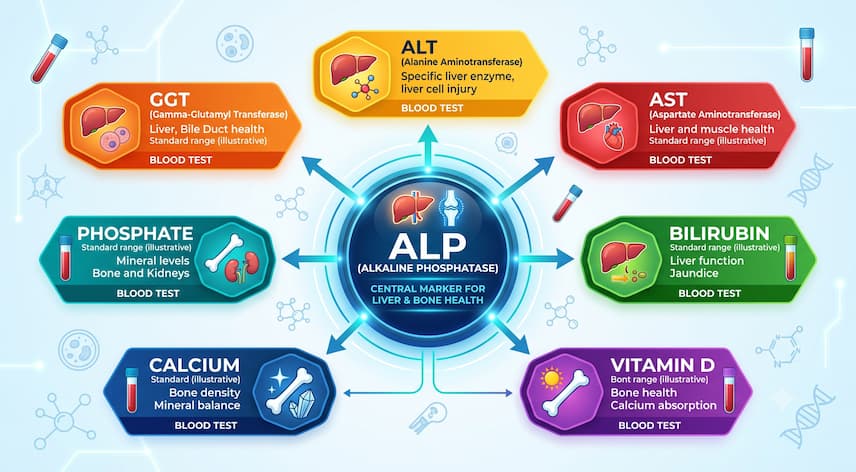
ALP is rarely interpreted alone. Considering it alongside other results provides a more complete picture:
- ALT and AST help assess liver cell activity and are often reviewed together with ALP when liver involvement is being considered.
- GGT helps clarify whether an elevated ALP is more likely to be liver-related.
- Bilirubin offers additional information about bile flow and liver function.
- Calcium and phosphate provide context when bone-related causes are relevant.
- Vitamin D can be considered alongside calcium and phosphate in bone-health evaluations.
Reviewing these results together, rather than focusing on ALP in isolation, generally provides more useful clinical information.
Test Preparation
Preparation for an ALP test depends on the specific laboratory panel it’s part of:
- Whether fasting is required depends on which other tests are included in the same blood draw, so it’s best to follow the specific instructions provided by your laboratory or healthcare provider.
- Let the lab or your provider know about relevant medications or supplements you’re taking, since some can be relevant to result interpretation.
- Follow the specimen collection instructions given by the testing facility.
There is no single universal preparation instruction that applies to every ALP test, since it depends on the broader panel being ordered.
How Long Do ALP Results Take?
Turnaround time for ALP results varies based on the laboratory performing the test, the specific panel it’s part of, and each facility’s processing arrangements. Some results may be available within a day, while others take longer depending on local lab workflows. Your healthcare provider or the testing laboratory can give you a more specific expected timeframe for your particular test.
Common Misconceptions
“High ALP always means liver disease.” ALP can rise due to liver, bile duct, or bone-related processes, as well as normal states like growth or pregnancy. Liver disease is one possibility among several, not an automatic conclusion.
“A normal ALP rules out every liver or bone problem.” ALP is just one laboratory marker. Some liver or bone conditions may not significantly affect ALP levels, so a normal result doesn’t rule out every possible concern.
“ALP alone can diagnose a condition.” ALP is a piece of a larger clinical picture. Diagnosis typically involves additional testing, medical history, and clinical evaluation, not a single lab value.
“Everyone should have the same ALP normal range.” Reference intervals vary by laboratory, age, sex, and life stage. There isn’t one universal number that applies to everyone.
“An isolated ALP elevation automatically means serious disease.” Isolated elevations have multiple possible explanations, including non-serious and physiological causes, and often prompt further evaluation rather than immediate concern.
What Patients Often Miss
A few points are easy to overlook when reviewing an ALP result:
- One laboratory value shouldn’t be viewed in isolation. ALP is most informative when considered alongside related tests and clinical history.
- Reference intervals vary. Comparing your result to a number from a different source or lab can be misleading.
- Age matters. Children, adolescents, and adults have different expected ALP patterns due to bone growth differences.
- Source matters. Whether elevated ALP originates from the liver or bone changes how it’s interpreted.
- Repeat testing may sometimes be considered. Healthcare professionals may recommend rechecking ALP over time to see whether a result changes.
- Related findings change interpretation. The same ALP number can mean different things depending on what other lab results show.
When to Discuss an Abnormal ALP Result With a Healthcare Professional
Any ALP result outside the expected reference interval is worth discussing with a healthcare professional, particularly if the finding is persistent across repeat testing or occurs alongside other symptoms. This doesn’t necessarily indicate a serious problem, but professional evaluation helps place the result in proper context.
If you’re experiencing severe or rapidly worsening symptoms, such as significant abdominal pain, yellowing of the skin or eyes, or other concerning changes, seek appropriate urgent medical care rather than waiting to discuss a lab result.
Patient Reassurance & Decision Support
Before discussing an ALP result with a healthcare professional, it can help to have on hand:
- Your laboratory report, including the reference interval listed
- Relevant medical history, including any prior liver or bone-related concerns
- A list of current medications and supplements
- Other recent laboratory results, if available
- Notes on any symptoms you’ve noticed, and when they started
Gathering this information can make your conversation more productive, though it doesn’t replace the evaluation itself.
Frequently Asked Questions
What is a serum alkaline phosphatase test?
It’s a blood test that measures the amount of alkaline phosphatase, an enzyme found mainly in the liver, bile ducts, and bone, circulating in your bloodstream. It’s often part of a broader laboratory panel and helps provide context for liver or bone-related evaluation.
What does a high ALP level mean?
A high ALP result means the enzyme is above the laboratory’s reference interval. It can be associated with liver, bile duct, or bone-related processes, or with normal states like growth or pregnancy. The specific cause depends on additional context.
What causes alkaline phosphatase levels to be high?
Possible contributors include liver or bile-duct-related processes, increased bone turnover, normal bone growth in children and teens, and pregnancy-related changes. A healthcare professional interprets the result using your full clinical picture.
What does an elevated alkaline phosphatase indicate?
An elevated result indicates more ALP is circulating than expected, but it doesn’t specify a cause on its own. Additional tests and clinical evaluation typically help determine whether the source is hepatic, bone-related, or physiological.
What are the symptoms of high alkaline phosphatase?
ALP itself usually doesn’t cause symptoms directly. Any symptoms present are typically related to the underlying condition associated with the abnormal result, and some people have no symptoms at all despite an out-of-range ALP level.
What does isolated raised ALP mean?
It means ALP is elevated while related liver tests remain within their expected range. This pattern raises the question of whether the source is the liver or another tissue, such as bone, and often prompts further evaluation.
What does low alkaline phosphatase mean?
A low ALP result falls below the laboratory’s reference interval and has several possible associations. Like high results, it’s interpreted within the context of your overall health rather than pointing to one specific cause.
What is the normal range for ALP?
There isn’t one universal number, since reference intervals vary by laboratory, age, sex, and life stage such as pregnancy. The most relevant range is the one listed on your specific lab report.
Can ALP be high without symptoms?
Yes. Many people have an ALP result outside the reference interval without noticing any symptoms, which is one reason routine laboratory testing can identify findings that might otherwise go unnoticed.
What other blood tests are considered with ALP?
ALP is often reviewed alongside GGT, ALT, AST, bilirubin, calcium, phosphate, and sometimes vitamin D. Together, these tests help provide a fuller picture than ALP alone.
Conclusion
Serum alkaline phosphatase is a laboratory marker, not a diagnosis. It reflects enzyme activity primarily from the liver, bile ducts, and bone, and both high and low results have multiple possible explanations that depend on the individual’s broader clinical picture. Reference intervals vary by lab, age, sex, and life stage, which is why the range on your own report matters more than a general number found online. If you have questions about your ALP result, an appropriate healthcare professional can help interpret it alongside your history and other laboratory findings.
Final Medical Disclaimer
This content is for informational purposes only and does not replace professional medical advice, diagnosis, or treatment. Laboratory results should be interpreted in the context of the individual’s overall health and the reference interval provided by the testing laboratory.

Mike Farrier is a seasoned technology journalist, digital trends researcher, and Senior Editor at Queknow. With over a decade of hands-on experience spanning web architecture, emerging tech, digital consumer products, and data-driven market insights, Mike bridges the gap between complex topics and actionable knowledge. He leads the editorial team to deliver rigorously fact-checked, up-to-date guides and comprehensive analysis across digital lifestyle, enterprise technology, and online business ecosystems. When not analyzing industry shifts, Mike actively tests consumer software and contributes to tech forums.
Recommended For You

Boundaries often get misunderstood, especially in families affected by addiction, mental health struggles, or long-standing conflict. They can sound cold.

Hip osteoarthritis (OA) is a common joint condition that develops as cartilage in the hip wears down over time. It

Introduction The phrase “airborne allergy” gets used in a lot of different ways. Sometimes it refers to classic environmental triggers