OA Right Hip ICD 10: A Complete Educational Coding Guide
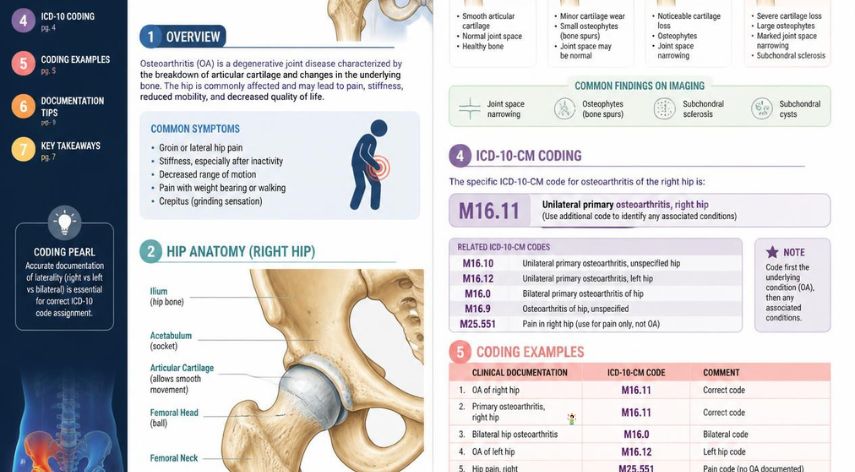
Hip osteoarthritis (OA) is a common joint condition that develops as cartilage in the hip wears down over time. It causes pain, stiffness, and reduced mobility, especially in older adults. Because hip OA can affect one or both sides of the body, accurate ICD-10-CM coding depends on knowing exactly which hip is involved.
ICD-10-CM codes exist so that healthcare providers, coders, and billers can describe a patient’s condition in a consistent, standardized way. A precise code supports clear medical records, appropriate care coordination, and accurate health data reporting. Small details, like which side of the body is affected, change which code applies.
This guide explains the ICD-10-CM code associated with right hip osteoarthritis, how it fits into the broader coding system, and what documentation elements support accurate code selection. It is written for patients, students, medical coders, billers, and healthcare administrators who want a clear, educational overview.
This article does not replace professional medical or coding advice.
Right hip osteoarthritis is typically coded as M16.11, “unilateral primary osteoarthritis, right hip,” in ICD-10-CM. This code applies when documentation confirms primary (age-related) osteoarthritis limited to the right hip. It is a billable code. Final code selection always depends on the treating provider’s complete clinical documentation and current official coding guidelines.
Executive Summary
Hip osteoarthritis involves gradual breakdown of the cartilage that cushions the hip joint. ICD-10-CM assigns specific codes based on which hip is affected and whether the osteoarthritis is primary or linked to another cause. Laterality, meaning whether the right, left, or both hips are involved, is a core part of accurate coding. Complete provider documentation, including affected side and OA type, supports correct code assignment. This article is educational only and does not provide diagnosis or reimbursement coding advice.
What Is Osteoarthritis of the Hip?
Osteoarthritis is a degenerative joint condition. In the hip, the smooth cartilage that allows the ball-and-socket joint to move easily gradually wears away. As cartilage thins, bones may rub against each other, which can lead to pain, stiffness, and inflammation.
Hip OA tends to develop slowly over years. It is most common in adults over 50, though it can appear earlier, particularly after joint injury. The condition is progressive, meaning symptoms often worsen gradually without intervention such as physical therapy, weight management, or other provider-directed care.
Understanding ICD-10-CM Coding
ICD-10-CM stands for the International Classification of Diseases, 10th Revision, Clinical Modification. It is the coding system used in the United States to document diagnoses for medical records, research, and billing purposes.
Diagnosis codes exist to create a shared language across healthcare settings. They allow providers, insurers, and public health systems to track conditions consistently. ICD-10-CM has strict documentation standards, meaning a code should only be assigned when the medical record supports it.
The coding hierarchy for osteoarthritis moves from general categories down to highly specific codes. Category M16 covers osteoarthritis of the hip specifically, with subcategories distinguishing primary versus secondary OA, and further subdivisions for laterality (right, left, bilateral, or unspecified).
ICD-10 Code for OA Right Hip
Within category M16 (osteoarthritis of hip), the subcategory M16.1 covers unilateral primary osteoarthritis of the hip. The specific codes are:
- M16.11 — Unilateral primary osteoarthritis, right hip
- M16.12 — Unilateral primary osteoarthritis, left hip
- M16.10 — Unilateral primary osteoarthritis, unspecified hip
M16.11 is the code most closely associated with the search term “OA right hip ICD-10.” It is a billable, specific code, meaning it can stand alone as a diagnosis in a medical record when documentation supports it.
Coding considerations include confirming that the osteoarthritis is primary (not caused by prior trauma, congenital abnormality, or another condition) and that the record clearly states the right hip is affected. If OA affects both hips, a different code, M16.0 (bilateral primary osteoarthritis of hip), applies instead.
Documentation Requirements
Accurate ICD-10-CM code selection depends on complete clinical documentation. Elements that typically support coding include:
- Affected side — the record should clearly state right, left, or bilateral involvement.
- Primary vs. secondary OA — primary OA has no identifiable prior cause; secondary OA follows injury, dysplasia, or another condition.
- Clinical history — symptom onset, duration, and progression.
- Imaging confirmation — X-ray or other imaging findings, referenced for educational purposes only and always ordered and interpreted by a qualified provider.
- Provider documentation — a clear diagnostic statement in the medical record, since coders cannot infer laterality or OA type without it.
This section is educational and does not constitute coding advice for reimbursement purposes.
Common Symptoms
People with right hip OA may notice:
- Stiffness, especially after waking or sitting for long periods
- Reduced range of motion in the hip joint
- Groin pain that may radiate to the thigh or buttock
- A limp or altered walking pattern
- Discomfort that increases with activity and eases with rest
Causes
Hip osteoarthritis develops from a combination of factors, including:
- Aging, which naturally reduces cartilage resilience
- Long-term cartilage degeneration from repeated joint stress
- Obesity, which increases mechanical load on the hip
- Prior hip injury, such as a fracture or dislocation
- Congenital abnormalities affecting hip joint shape
- Repetitive stress from certain occupations or activities
Risk Factors
Common risk factors associated with hip OA include:
- Advancing age
- Higher body mass index (BMI)
- Occupations involving repetitive joint loading
- Family history or genetic predisposition
- Previous trauma to the hip joint
- Inflammatory joint conditions that accelerate cartilage wear
Diagnosis (Educational Only)
Diagnosis of hip osteoarthritis is typically based on a combination of medical history, physical examination, and imaging studies ordered by an appropriate healthcare provider. A provider evaluates symptom patterns, joint mobility, and imaging findings to determine whether OA, and which type, is present.
This section is provided for educational purposes only. QueKnow does not perform diagnosis, and any individual concerned about hip symptoms should consult a licensed healthcare professional.
Differential Diagnosis
Several conditions can present with similar symptoms to hip OA. A provider may consider:
- Rheumatoid arthritis — an autoimmune condition causing joint inflammation, often affecting multiple joints symmetrically.
- Bursitis — inflammation of the fluid-filled sac near the hip joint, often causing more localized tenderness.
- Avascular necrosis — loss of blood supply to hip bone tissue, which can mimic OA symptoms on imaging.
- Hip labral pathology — tears in the cartilage ring around the hip socket, often linked to mechanical symptoms like catching or locking.
- Referred lumbar pain — lower back conditions that produce pain felt in the hip or groin area.
Related ICD-10 Codes
| Topic | What It Refers To | Documentation & Coding Notes |
|---|---|---|
| Osteoarthritis left hip ICD-10 | M16.12 — unilateral primary OA, left hip | Requires documentation confirming left-side involvement |
| Osteoarthritis hip ICD-10 (general) | M16 category | Parent category; specific codes depend on side and type |
| Right hip OA ICD-10 | M16.11 | Same code as OA right hip; billable and specific |
| Left shoulder osteoarthritis ICD-10 | M19.012 — primary OA, left shoulder | Shoulder OA falls under M19, not M16 |
| Right shoulder osteoarthritis ICD-10 / OA right shoulder | M19.011 — primary OA, right shoulder | Requires laterality and primary/secondary distinction |
| Shoulder arthritis / shoulder OA ICD-10 | M19.01 category (M19.011, M19.012, M19.019) | Unspecified shoulder code used only when side is undocumented |
| Osteoarthritis of the shoulder ICD-10 | M19.019 if side unspecified | Specificity is preferred over unspecified codes when documented |
| Acromioclavicular joint osteoarthritis ICD-10 | Often coded under M19.01x | AC joint OA is typically classified with shoulder OA codes |
| DJD left shoulder / DJD right shoulder ICD-10 | Same M19.01x codes | “DJD” (degenerative joint disease) and “osteoarthritis” are generally coded identically |
| Osteoarthritis hands / hand arthritis ICD-10 | M19.041 (right), M19.042 (left), M19.049 (unspecified) | Hand OA falls under M19.04 |
| ICD-10 M19.90 | Unspecified osteoarthritis, unspecified site | Used only when neither joint nor laterality is documented |
This table is for educational comparison. Final code selection always depends on complete provider documentation.
Common Coding Mistakes
Coding errors involving osteoarthritis often include:
- Using an unspecified code (like M19.90) when the record actually documents a specific joint and side
- Missing laterality, leaving the coder to guess whether the right, left, or both hips are involved
- Incomplete documentation that does not distinguish primary from secondary osteoarthritis
Avoiding these errors starts with clear, specific provider documentation at the point of care.
Frequently Misunderstood ICD-10 Concepts
OA vs. DJD terminology. “Osteoarthritis” and “degenerative joint disease” describe the same underlying process and are generally coded using the same ICD-10-CM codes, though documentation conventions can vary by provider.
Unspecified vs. specified OA. Unspecified codes exist for situations where the record lacks detail. Whenever documentation supports it, a specified code (with joint and side) is more informative and accurate.
Primary vs. secondary OA. Primary OA has no clear prior cause and is often linked to aging. Secondary OA follows an identifiable event, such as trauma, infection, or a structural abnormality, and is coded differently.
Preparing for a Medical Visit
Patients preparing to discuss hip symptoms with a provider may find it helpful to:
- Track when symptoms started and how they have changed over time
- Note which activities worsen or ease discomfort
- Bring any prior imaging reports or records of previous joint injuries
- List current medications, including over-the-counter pain relievers
- Prepare questions about diagnosis, documentation, and next steps
Frequently Asked Questions
What is the ICD-10 code for OA of the right hip?
The typical code is M16.11, unilateral primary osteoarthritis of the right hip. This applies when documentation confirms primary OA limited to the right side. A healthcare provider or certified coder determines the final code based on complete medical records.
What is the ICD-10 code for shoulder osteoarthritis?
Shoulder OA codes fall under category M19.01. Right shoulder is M19.011, left shoulder is M19.012, and unspecified shoulder is M19.019. The correct code depends on documented laterality and OA type.
Is there a specific ICD-10 code for hand osteoarthritis?
Yes. Primary osteoarthritis of the hand is coded M19.041 for the right hand, M19.042 for the left hand, and M19.049 when the side is unspecified in the record.
When is the unspecified osteoarthritis code M19.90 used?
M19.90 applies when documentation does not specify which joint or side is affected. Coders generally prefer more specific codes whenever the medical record supports them.
What documentation supports accurate OA coding?
Supporting documentation typically includes the affected joint, laterality, whether the OA is primary or secondary, symptom history, and any relevant imaging findings noted by the treating provider.
Are ICD-10-CM guidelines updated regularly?
Yes. ICD-10-CM codes are reviewed and updated annually by federal health agencies. Coders and billers should reference the current fiscal year’s official guidelines rather than relying on outdated code sets.
Why does laterality matter in ICD-10 coding?
Laterality specifies which side of the body is affected. Many musculoskeletal codes, including those for hip, shoulder, and hand OA, require this detail for accurate, specific coding rather than defaulting to unspecified categories.
What is the difference between OA and DJD in medical records?
Both terms generally describe the same degenerative cartilage process and are typically coded the same way in ICD-10-CM, though a provider’s chosen terminology may vary by specialty or documentation style.
Can osteoarthritis affect more than one joint at a time?
Yes. Osteoarthritis can affect multiple joints, including both hips, shoulders, or hands simultaneously. Each affected joint and side is typically documented and coded individually based on the medical record.
Does this article provide a diagnosis or coding decision for my case?
No. This article is educational only. Diagnosis and final code assignment depend on a qualified healthcare provider’s evaluation and complete documentation, along with current official coding guidelines.
Conclusion
Right hip osteoarthritis is commonly associated with ICD-10-CM code M16.11, used when documentation confirms primary osteoarthritis limited to the right hip. Related codes cover the left hip, both hips, and other joints such as the shoulder and hand, each requiring specific documentation of laterality and OA type. Accurate coding depends on complete clinical records rather than assumption. This guide is intended for educational purposes and does not replace professional medical or coding advice. Readers with symptoms or coding questions specific to their situation should consult an appropriate healthcare professional or certified medical coder.
This content has been reviewed for clinical accuracy by our laboratory and medical content team.
Medical Disclaimer: This content is for informational purposes only and does not replace professional medical advice, diagnosis, or treatment. ICD-10-CM codes should always be assigned based on complete clinical documentation and current official coding guidelines.

Mike Farrier is a seasoned technology journalist, digital trends researcher, and Senior Editor at Queknow. With over a decade of hands-on experience spanning web architecture, emerging tech, digital consumer products, and data-driven market insights, Mike bridges the gap between complex topics and actionable knowledge. He leads the editorial team to deliver rigorously fact-checked, up-to-date guides and comprehensive analysis across digital lifestyle, enterprise technology, and online business ecosystems. When not analyzing industry shifts, Mike actively tests consumer software and contributes to tech forums.
Recommended For You
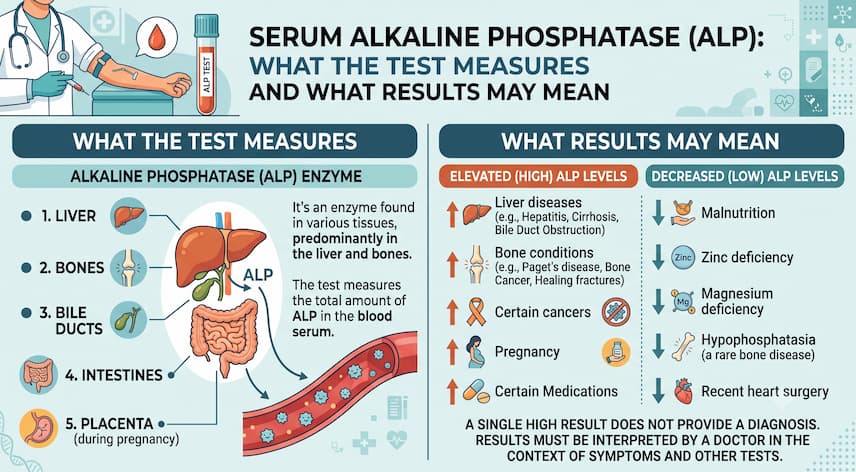
What Is Serum Alkaline Phosphatase? Alkaline phosphatase is an enzyme, a type of protein that helps speed up specific chemical

Boundaries often get misunderstood, especially in families affected by addiction, mental health struggles, or long-standing conflict. They can sound cold.

Introduction The phrase “airborne allergy” gets used in a lot of different ways. Sometimes it refers to classic environmental triggers