Airborne Allergy: What It Really Means and What Doesn’t Count
Introduction
The phrase “airborne allergy” gets used in a lot of different ways. Sometimes it refers to classic environmental triggers like pollen or dust mites. Other times, people use it to ask whether a food allergen, like peanuts or fish, could cause a reaction just from being nearby or catching a whiff of it. That second question is where a lot of confusion sits.
This QueKnow guide separates the two ideas. It explains what airborne allergens actually are, how inhalation exposure differs from eating or touching an allergen, and walks through common food and substance questions, including peanuts, dairy, bananas, fish, cheese, shellfish, nuts, eggs, gluten, and latex. None of this replaces an evaluation from a healthcare professional, but it should make the underlying concepts much clearer.
What Does Airborne Allergy Mean?
“Airborne allergy” isn’t always a precise clinical term. It’s commonly used to describe an allergic reaction that happens after inhaling allergen-containing material, rather than eating it or touching it directly. In medical terms, this is closer to inhalant allergy or allergic rhinitis when it involves environmental allergens like pollen or dust.
The key idea is exposure route. An allergen has to actually reach the immune system in a way it recognizes, whether through the nose and airways, the digestive tract, or the skin. For airborne exposure specifically, that means allergen-containing particles need to be present in the air in a form and concentration the body can detect and react to. Simply being in the general vicinity of a substance doesn’t automatically mean that has happened.
What Are Airborne Allergens?

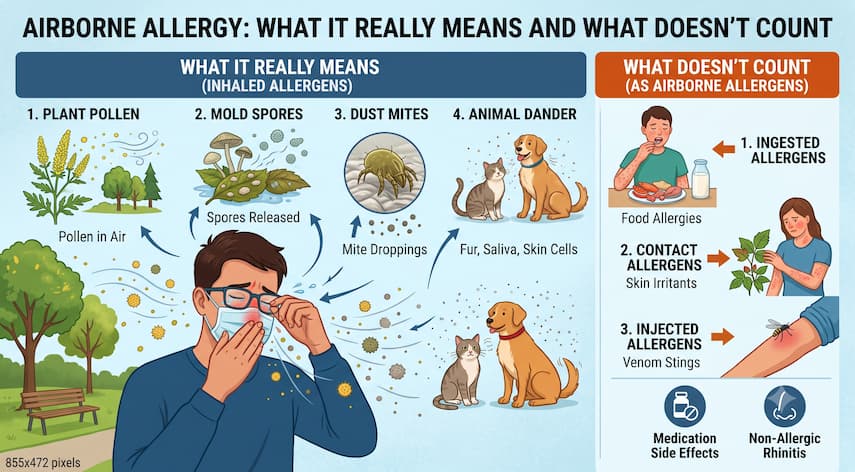
The most well-established airborne allergens are environmental, including:
- Pollen — released by trees, grasses, and weeds, especially during certain seasons
- Mold spores — released into the air from mold growth indoors or outdoors
- Dust mite particles — allergen-containing material from dust mite waste, often stirred up from bedding, carpets, or upholstery
- Animal dander — tiny skin flecks and proteins shed by pets, which can become airborne
- Occupational allergens — certain workplace materials, such as flour dust in bakeries or specific chemical particles, that become airborne in specific settings
It helps to separate an allergen from an irritant. An allergen triggers a true immune response, involving antibodies and inflammatory chemicals like histamine. An irritant, such as smoke or strong fumes, can cause similar symptoms, like coughing or watery eyes, without involving the immune system in the same way. The two can look alike on the surface but work through different mechanisms.
Airborne Allergy Symptoms
Symptoms associated with inhaling airborne allergens commonly include:
- Sneezing
- Runny or stuffy nose
- Itchy nose
- Itchy or watery eyes
- Coughing
- Wheezing
- Throat irritation
- Skin symptoms, in some cases, depending on the allergen and exposure
Symptoms vary depending on the specific allergen, how much exposure occurred, and individual sensitivity. Having one or more of these symptoms doesn’t confirm an airborne allergy on its own, since similar symptoms can come from irritants, infections, or other conditions. An appropriate healthcare professional can help sort out the actual cause.
Airborne Food Allergies

This is where a lot of the confusion around “airborne allergy” comes from, and it deserves a careful answer.
For allergen-containing material to cause a reaction through inhalation, it generally needs to actually become part of the air, as particles, droplets, dust, or aerosolized material, in a concentration high enough to trigger a response. Just having a food present in a room doesn’t automatically mean this has happened.
A few points matter here:
- Food odor is not the same as allergen exposure. Smell is caused by volatile compounds, which are generally different from the proteins responsible for allergic reactions.
- Certain activities can change exposure circumstances. Cooking, steaming, grinding, spraying, or processing a food can release particles or aerosols into the air in a way that simply having the food nearby does not.
- Occupational and food-processing environments differ from everyday settings. Someone working around large volumes of a food ingredient, such as in a factory or commercial kitchen, may encounter airborne exposure that wouldn’t occur in a typical home or restaurant setting.
- Individual reactions vary. Even within similar exposure circumstances, not everyone with a food allergy will react the same way to airborne particles.
These are meaningful exceptions, not the everyday rule. For most people in most situations, being near a food is not equivalent to airborne allergen exposure.
Specific Food & Substance Questions
Airborne Allergy to Peanuts
Being in the same room as peanuts, or smelling them, is not the same as being exposed to airborne peanut protein. Peanut allergens are primarily encountered through eating or direct contact. In specific circumstances, such as peanut dust generated during processing or certain confined food-preparation settings, airborne particles could theoretically contribute to exposure, but this is different from the everyday experience of smelling peanuts or being near someone eating them.
Airborne Allergy to Dairy
Dairy allergens are mainly encountered through drinking or eating dairy products, or through direct contact. Airborne exposure to dairy protein would generally require dairy material to become aerosolized, such as during certain industrial processing, rather than through everyday proximity to dairy foods.
Airborne Allergy to Bananas
There’s no strong basis for routine airborne exposure to banana allergens under normal circumstances. Reactions to bananas are typically associated with eating or handling the fruit directly, not with being near one or smelling it.
Airborne Allergy to Fish
Fish allergy is a notable exception where airborne exposure has been more specifically discussed, particularly during cooking. Steam and vapor released while fish is being cooked, especially boiled or fried, can carry allergen-containing particles into the air in some settings. This differs from simply being near uncooked fish or smelling it in a store.
Airborne Allergy to Cheese
Similar to other dairy products, cheese odor comes from volatile compounds related to fermentation and aging, not necessarily from allergenic proteins. Airborne allergic reactions to cheese odor alone are not well supported; ingestion or direct contact remains the primary exposure route.
Shellfish Airborne Allergy
Like fish, shellfish is sometimes discussed in the context of cooking-related exposure, since boiling or steaming shellfish can release steam and particles into the air. Ordinary proximity to shellfish, such as walking past a seafood counter, is a different scenario and not the same as documented cooking-related airborne exposure.
Nut Airborne Allergy
As with peanuts, tree nuts are primarily an ingestion or direct-contact allergen. Airborne exposure would generally require specific circumstances, such as nut dust or processing activities, rather than ordinary proximity to nuts or nut products.
Egg Airborne Allergy
Egg allergens are mainly encountered through eating or handling eggs and egg-containing foods. Cooking activities that generate steam or particles, similar to other foods, could theoretically contribute to airborne exposure in certain settings, but this isn’t the typical way egg allergy reactions occur.
Is Gluten an Airborne Allergy?
This is an important distinction. Gluten-related conditions, such as celiac disease and non-celiac gluten sensitivity, are not classified as airborne allergies; they involve an immune or digestive response to ingested gluten. Separately, wheat allergy is a true allergy, and inhaling airborne wheat or flour dust, sometimes seen in baking environments, can trigger respiratory symptoms in people with a wheat allergy. That’s different from gluten sensitivity and shouldn’t be confused with it.
Is Latex an Airborne Allergy?
Latex exposure can occur through skin contact, mucous membrane contact, or, in some cases, inhalation. Certain latex products, particularly powdered latex gloves, can release latex-allergen particles into the air when handled, which has been documented especially in healthcare and occupational settings. Exposure risk depends heavily on the type of latex product and environmental conditions, so this isn’t a universal risk with all latex items.
Is Airborne Allergy Real?
Yes, airborne allergen exposure is a real and well-documented phenomenon, particularly for environmental allergens like pollen, mold, dust mites, and animal dander. However, not every allergy is commonly transmitted through the air. Whether a specific allergen can realistically become airborne depends on the substance itself and the circumstances of exposure, such as cooking, processing, or occupational activity.
Food-related airborne reactions are a narrower category. They require the allergen to actually become part of the air in a meaningful way, which is different from smelling a food or simply being near it. Recognizing this distinction helps separate genuine risk from common misconceptions.
Airborne Allergy Test
Evaluating a possible airborne allergy generally starts with a healthcare professional reviewing:
- Medical history, including symptom patterns and timing
- Exposure history, such as where and when symptoms tend to occur
- Skin testing, where small amounts of allergen extract are applied to the skin to observe a reaction
- Blood-based specific IgE testing, which measures immune antibodies related to particular allergens
- Other testing, when clinically appropriate, based on an individual’s history and symptoms
Testing results are interpreted alongside a person’s history and symptoms, not in isolation. A healthcare professional is best positioned to decide which tests are appropriate and how to interpret them for a specific situation.
Airborne Allergy vs. Other Reaction Types
| Exposure Type | Example | What It Means |
|---|---|---|
| Inhalation | Pollen | Allergen enters through breathing |
| Ingestion | Eating a food | Allergen enters through the digestive system |
| Skin contact | Touching an allergen | Exposure occurs through direct skin contact |
| Irritant exposure | Smoke | May cause symptoms without an allergic immune mechanism |
Keeping “allergic reaction” and “irritant response” separate matters, since the two can produce similar symptoms but involve different underlying processes and different management approaches.
Smell vs. Allergen Exposure
Smelling something means volatile compounds have reached receptors in the nose, but those compounds are usually different from the actual proteins that trigger allergic reactions. Detecting an odor doesn’t confirm that allergen-containing particles were inhaled in a meaningful amount. This is part of why smelling a food, like peanuts or fish, isn’t automatically equivalent to airborne allergen exposure, even though it can feel intuitive to assume otherwise.
Why Exposure Route Matters
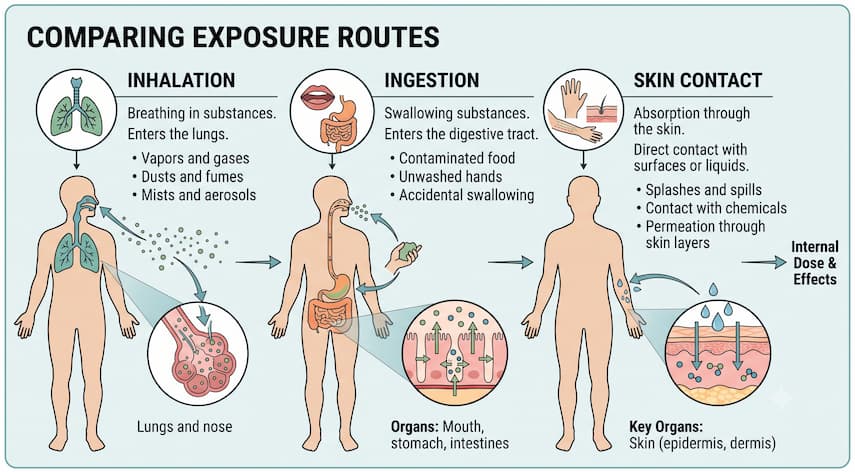
Ingestion, skin contact, and inhalation all expose the immune system to an allergen differently. Ingested allergens interact with the digestive system, skin contact involves the skin’s immune components, and inhalation involves the respiratory tract. A person’s allergy may be more strongly associated with one exposure route than another, which is part of why airborne reactions to certain foods are documented in specific contexts, like cooking steam, but aren’t assumed to apply universally to every form of contact.
Common Airborne Allergy Misconceptions
- “Smelling a food means I inhaled its allergen.” Odor and allergen exposure are not the same thing.
- “Being in the same room as an allergen guarantees exposure.” Proximity alone doesn’t confirm that allergen-containing particles reached the air in a meaningful concentration.
- “Touching packaging is the same as airborne exposure.” That’s a contact exposure, not an inhalation one, and involves different considerations.
- “All airborne particles are allergens.” Many airborne particles are irritants or simply dust, without triggering a true immune response.
- “Gluten sensitivity is an airborne allergy.” Gluten-related disorders involve ingestion, not inhalation, and are a separate category from wheat allergy.
- “All latex products carry the same airborne risk.” Airborne latex exposure is more associated with specific products, like powdered gloves, than with latex items generally.
Patient Guidance
If you’re trying to understand a possible airborne reaction, it can help to:
- Document when and where symptoms occur
- Note specific activities involved, such as cooking, cleaning, or being in a particular environment
- Track how close you were to a suspected allergen and for how long
- Discuss suspected triggers with a healthcare professional rather than assuming a cause
- Understand that allergy testing helps clarify sensitivities but is interpreted alongside your history, not as a standalone answer
When to Seek Urgent or Emergency Care
Most airborne allergy symptoms are uncomfortable rather than dangerous, but reactions can occasionally become severe. Seek emergency medical care immediately if symptoms include:
- Difficulty breathing
- Throat or tongue swelling
- Fainting or severe dizziness
- Widespread, severe symptoms affecting multiple body systems
- Signs of anaphylaxis
Anaphylaxis is a medical emergency, regardless of whether the trigger was airborne, ingested, or contact-based.
A Note of Reassurance
Trying to understand a possible airborne reaction, especially involving food, can feel confusing and a little unsettling. It’s a reasonable thing to want clarity on. The good news is that genuine airborne food-allergen exposure is a fairly specific and well-defined category, not something that happens in every situation involving smell or proximity. If you’re unsure what’s causing your symptoms, consult an appropriate healthcare professional for an individualized assessment.
Frequently Asked Questions
What is an airborne allergy?
An airborne allergy generally refers to an allergic reaction triggered by inhaling allergen-containing particles, such as pollen, mold spores, or dust mite debris. The term is used broadly and isn’t always a strict clinical diagnosis. Exposure depends on the specific allergen and how it enters the air.
Are airborne allergies real?
Yes, airborne allergen exposure is well documented, especially for environmental triggers like pollen, mold, and dust mites. Not every allergy is commonly transmitted through the air, though, so whether a specific substance poses an airborne risk depends on the allergen and exposure circumstances.
What are common airborne allergens?
Common airborne allergens include pollen from trees, grasses, and weeds, mold spores, dust mite particles, and animal dander. Certain occupational materials, like flour dust, can also become airborne allergens in specific work settings.
Can peanut allergens become airborne?
Ordinary proximity to peanuts or smelling them is not the same as airborne peanut exposure. In specific settings, such as peanut dust during processing, airborne particles could theoretically contribute to exposure, but this differs from everyday situations like being near someone eating peanuts.
Can fish cause an airborne allergic reaction?
Fish is one of the more specifically documented examples, particularly involving cooking steam or vapor from boiling or frying, which can carry allergen particles into the air. This differs from simply being near uncooked fish or smelling it.
Can dairy allergens become airborne?
Airborne dairy exposure would generally require dairy material to become aerosolized, such as in certain processing settings, rather than everyday proximity to dairy foods. Ingestion and direct contact remain the primary exposure routes for dairy allergy.
Is gluten an airborne allergy?
No. Gluten-related conditions like celiac disease involve ingestion, not inhalation. Wheat allergy is a separate, true allergy, and inhaling airborne wheat or flour dust can trigger symptoms in people with that specific allergy, but this shouldn’t be confused with gluten sensitivity.
Can latex cause airborne exposure?
Yes, in some cases. Certain latex products, especially powdered latex gloves, can release latex-allergen particles into the air when handled, which has been documented in some occupational settings. Risk depends on the specific product and environment.
What are airborne allergy symptoms?
Common symptoms include sneezing, runny or stuffy nose, itchy nose, itchy or watery eyes, coughing, wheezing, and throat irritation. Symptoms vary by allergen, exposure amount, and individual sensitivity, and don’t confirm a specific allergy on their own.
How is airborne allergy testing performed?
Evaluation typically starts with a review of medical and exposure history, followed by skin testing or blood-based specific IgE testing when appropriate. A healthcare professional interprets results alongside your symptoms and history rather than using test results alone.
Medical Disclaimer:
This article is for general educational purposes only and does not diagnose allergies or provide personalized medical advice. If you experience severe allergic symptoms, such as difficulty breathing or throat swelling, seek emergency medical care immediately.

Mike Farrier is a seasoned technology journalist, digital trends researcher, and Senior Editor at Queknow. With over a decade of hands-on experience spanning web architecture, emerging tech, digital consumer products, and data-driven market insights, Mike bridges the gap between complex topics and actionable knowledge. He leads the editorial team to deliver rigorously fact-checked, up-to-date guides and comprehensive analysis across digital lifestyle, enterprise technology, and online business ecosystems. When not analyzing industry shifts, Mike actively tests consumer software and contributes to tech forums.
Recommended For You
What Is Serum Alkaline Phosphatase? Alkaline phosphatase is an enzyme, a type of protein that helps speed up specific chemical

Boundaries often get misunderstood, especially in families affected by addiction, mental health struggles, or long-standing conflict. They can sound cold.

Hip osteoarthritis (OA) is a common joint condition that develops as cartilage in the hip wears down over time. It