AI Avatar Chat: How Interactive AI Conversations Work
A chat window with a typing indicator used to be the standard for AI-powered customer interaction. Now, a growing number of businesses are testing something more visual: an animated avatar that talks, listens, and responds in something closer to a real conversation.
The appeal is obvious. The technical reality is more nuanced. This Queknow guide explains how AI avatar chat actually works, how it differs from a standard chatbot, and where it genuinely adds value for a business versus where it’s mostly a novelty. If you’re still deciding between formats, our broader guide to AI chatbot platforms covers the text-based side of that comparison in more detail.
What Is AI Avatar Chat?
AI avatar chat combines a visual or animated character with conversational AI to create an interactive, humanlike chat experience. The avatar handles voice, expression, and animation, while an underlying AI system processes language and generates responses. It can operate through text, voice, or both, depending on the platform.
The avatar itself is primarily a visual and audio interface. The actual conversational intelligence — understanding what someone said and generating a relevant reply — typically comes from a separate AI model or conversational system connected behind the scenes.
How Does AI Avatar Chat Work?

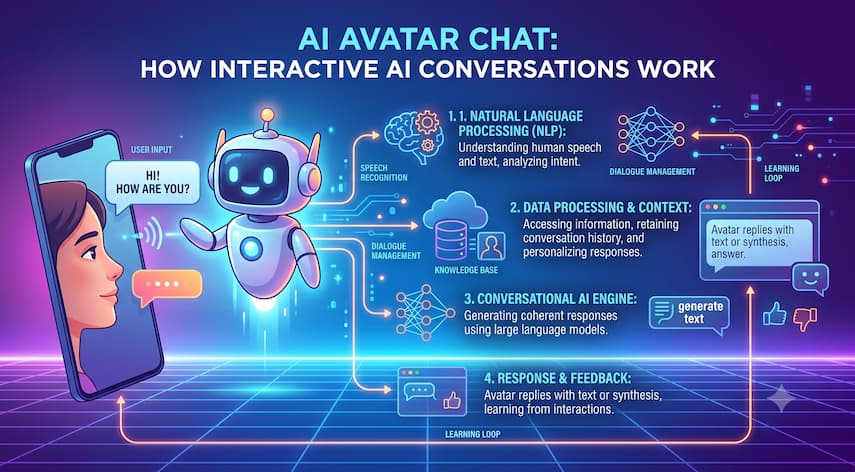
Most AI avatar chat systems follow a similar general pipeline, even though specific implementations vary by provider:
- User input — The person types a message or speaks into a microphone
- Speech or text processing — Spoken input is converted to text through speech recognition; typed input goes directly to the next step
- AI reasoning — A language model processes the input and generates a relevant response, often pulling from a connected knowledge base
- Response generation — The system produces the text of the reply
- Voice and animation — Text-to-speech converts the response into spoken audio, while animation systems sync the avatar’s mouth movements and expressions to match
- Visual output — The avatar delivers the response on screen, in something approximating real time
Each stage introduces its own potential delay or point of failure, which matters when evaluating how “real-time” a given platform actually feels in practice.
What Is an AI Avatar Chatbot?
An AI avatar chatbot is a chatbot that uses an avatar as its interface instead of, or in addition to, a plain text window. The underlying chatbot logic — how it interprets questions and generates answers — works the same way it would without an avatar. The avatar adds a visual and often vocal layer on top of that existing conversational system.
This distinction matters because avatar quality and conversational intelligence are separate things. A highly realistic avatar can still give poor answers if the underlying AI model or knowledge base isn’t well configured, and a simple avatar can deliver excellent answers if it’s connected to a strong conversational system.
AI Avatar Chat vs Traditional Chatbots

| Factor | AI Avatar Chat | Traditional Chatbot |
|---|---|---|
| Visual interface | Animated character with expressions and movement | Typically a text window, sometimes with a static icon |
| Text interaction | Often supported alongside voice | Primary or only interaction method |
| Voice interaction | Frequently supported through text-to-speech and speech recognition | Rarely supported natively |
| Real-time conversation | Can feel more immersive, but depends on processing speed across multiple systems | Generally faster since there’s no animation or voice rendering involved |
| User experience | More engaging for some users, but can feel unnecessary for simple queries | Familiar and efficient for straightforward information requests |
| Implementation | Generally more complex, involving avatar rendering, voice, and AI integration | Simpler to implement and maintain |
| Best use cases | Product demos, onboarding, immersive customer experiences | FAQs, support tickets, quick information lookups |
Neither format is universally better. A traditional chatbot often handles simple, high-volume questions more efficiently, while an avatar can add value in contexts where visual engagement or a more personal-feeling interaction matters.
What Is an AI Avatar Chat App?
An AI avatar chat app is a standalone application — mobile, desktop, or web-based — built around avatar-driven conversation as its core feature, rather than an avatar embedded within a broader business platform. Depending on the app, users should expect:
- A visual avatar as the primary interface
- Text or voice input options, or both
- Some degree of customization for the avatar’s appearance or personality
- Varying levels of AI capability depending on the underlying model
- Potential limitations on conversation length, topics, or usage without a paid plan
Features vary significantly by provider, so confirm specifics like available AI models, customization options, and pricing directly with each app before assuming capabilities.
Can AI Avatars Talk in Real Time?

Many AI avatar platforms support real-time or near-real-time conversation, though the experience depends on how quickly each stage of the pipeline runs.
Real-time AI avatar talk relies on:
- Speech recognition — Converting spoken words to text quickly and accurately
- AI response generation — How fast the underlying model can process input and produce a reply
- Text-to-speech — Converting the generated response into natural-sounding audio
- Avatar animation — Syncing facial movement and expression to the audio in real time
- Streaming — Whether the system streams partial responses as they’re generated, rather than waiting for the full reply
- Latency — The cumulative delay across all of these steps, which affects how natural the conversation feels
Even well-optimized systems introduce some delay at each stage. “Real time” in this context usually means noticeably fast, not instantaneous, and actual performance varies by platform, network conditions, and query complexity.
Can You Use AI Avatar Chat With ChatGPT?
Some AI avatar platforms can connect to ChatGPT or similar large language models as the underlying conversational engine, but this depends entirely on the specific product and its available integrations.
It helps to separate three distinct things:
- ChatGPT is a conversational AI system that processes language and generates responses
- AI avatars are a visual and voice interface that can sit on top of a conversational AI system
- Third-party avatar platforms may or may not offer an official integration with ChatGPT specifically, versus other AI models
Do not assume a specific avatar product officially integrates with ChatGPT unless that integration is clearly documented on the provider’s official page. Some platforms use their own proprietary AI models, others offer a choice of models, and some connect through general-purpose APIs rather than an official partnership.
What Makes Interactive AI Avatar Chat Useful?
Interactive AI avatar chat can add value in specific ways that a plain text chatbot doesn’t replicate as easily:
- Engagement — A visual, responsive character can hold attention longer than static text, particularly for product demos or educational content
- Accessibility — Voice interaction can help users who prefer speaking over typing, or who have difficulty with text-based interfaces
- Personalization — Some platforms allow avatar customization to match a brand’s tone or persona, tying into the broader approach covered in Queknow’s guide on AI transforming personalized customer experiences
- Conversational interfaces — Combining voice and visual cues can make interactions feel closer to talking with a person
- Business applications — The format lends itself to demonstrations, walkthroughs, and guided experiences more naturally than a text box
These benefits are context-dependent. For a quick support question, a fast text-based chatbot may outperform an avatar experience simply by being more efficient.
Business Use Cases for AI Avatar Chat
- Customer support — Handling common questions with a more visual, guided interaction
- Website assistance — Greeting visitors and helping them navigate a site or find information
- Sales — Walking prospects through product features or answering qualifying questions
- Product education — Demonstrating how a product works through guided conversation
- Employee training — Delivering interactive onboarding or training content, an approach that pairs well with the workflow ideas in Queknow’s guide on how AI is transforming project management
- Onboarding — Guiding new users or customers through initial setup steps
- Education — Presenting instructional content in a more engaging format
- Hospitality — Providing guest information or concierge-style assistance
- Marketing — Creating interactive brand experiences or campaigns
For healthcare, financial, legal, or other regulated contexts, an AI avatar should generally be positioned as providing general information rather than professional advice, and any implementation should be reviewed against applicable industry regulations before deployment.
Benefits of AI Avatar Chat
- More engaging interactions for users who respond well to visual and voice-based communication
- Potentially improved accessibility for people who prefer speaking to typing
- A more guided experience for tasks like product walkthroughs or onboarding
- Brand personality that can be expressed through avatar design and tone
- Multichannel flexibility, since many platforms support both text and voice input
These are realistic, general benefits rather than guaranteed outcomes. Actual results depend on implementation quality, the underlying AI model, and how well the use case fits an avatar-based format.
Limitations and Risks of AI Avatar Chat
- Hallucinations — Like any AI system, avatar-driven chat can generate inaccurate or fabricated information, especially without a strong connected knowledge base
- Privacy — Voice and conversational data may be collected and processed, which raises questions about storage, retention, and third-party access
- Security — Systems handling customer data need appropriate access controls and data protection measures
- Latency — Multi-step processing (speech recognition, AI reasoning, voice generation, animation) can introduce noticeable delay
- Accuracy — Speech recognition errors can lead to misunderstood input and irrelevant responses
- Accessibility — Voice-heavy interfaces may create barriers for some users, even as they help others
- Cost — Avatar rendering, voice generation, and AI processing typically cost more than a basic text chatbot
- Integration — Connecting an avatar system to existing business tools and data sources adds technical complexity
- User acceptance — Not every audience responds positively to avatar-based interaction; some prefer plain text
- Maintenance — Keeping the avatar’s knowledge current and the experience polished requires ongoing effort
How to Choose the Best AI Avatar Chat Platform
There’s no single “best” AI avatar chat platform for every business. The right choice depends on your specific use case, technical resources, and budget. Rather than looking for a universal winner, evaluate options against a consistent framework:
- Define your use case. Decide whether you need customer support, sales assistance, training, or a marketing experience.
- Assess required interaction modes. Determine whether you need text, voice, or both.
- Check latency and performance. Test the actual response speed, not just marketing claims.
- Evaluate avatar customization. Confirm you can match the avatar’s appearance and tone to your brand.
- Review AI model options. Understand which underlying AI system powers the conversation and whether you have any choice in that.
- Confirm knowledge-base integration. Check whether the avatar can pull accurate answers from your actual content.
- Check integration capabilities. Verify compatibility with your CRM, help desk, or other existing tools.
- Review privacy and security practices. Understand how voice and conversation data is collected, stored, and used.
- Compare total cost. Look beyond the base subscription to usage-based charges for voice, rendering, and AI processing.
Key Features to Look For
- Real-time conversation — How quickly and smoothly the system responds
- Voice interaction — Quality of speech recognition and generated speech
- Avatar customization — Ability to adjust appearance, tone, and branding
- AI model options — Flexibility in which underlying AI system powers responses
- Knowledge-base integration — Accuracy and relevance of answers based on your content
- API access — Ability to extend or customize functionality programmatically
- CRM integrations — Whether conversations and leads sync with your existing sales tools
- Analytics — Visibility into conversation volume, common questions, and outcomes
- Multilingual support — Whether the avatar can converse in multiple languages
- Security — Data protection measures for voice and conversation data
- Privacy controls — Consent management and data handling transparency
- Scalability — Whether the platform can handle increased usage without major limitations, a consideration explored further in Queknow’s guide on how cloud scalability grows with your business.
- Accessibility — Whether the interface accommodates users with different needs
AI Avatar Chat Pricing and Cost Considerations
Pricing varies significantly by provider and depends on several cost drivers. Rather than a fixed price, expect costs influenced by:
- Usage — Overall volume of conversations or interactions
- Number of conversations — Some platforms charge per conversation or per session
- AI model usage — Costs tied to the underlying language model processing requests
- Voice generation — Text-to-speech processing typically carries its own cost
- Avatar rendering — Generating and animating the visual avatar can add processing cost
- API usage — Programmatic access may be billed separately from the core platform
- Hosting — Where and how the avatar experience is hosted can affect cost
- Integrations — Premium integrations with CRM or other business tools may require a higher-tier plan
- Custom development — Highly customized avatar experiences may involve upfront development costs
- Enterprise features — Advanced security, analytics, or support options are often reserved for higher-cost plans
Because pricing structures and tiers change frequently, verify current, USD-denominated pricing directly on each provider’s official page rather than relying on outdated comparisons.
Is AI Avatar Chat Right for Your Business?
The right choice depends on your specific goal, audience, and resources.
AI avatar chat may be worth considering if you:
- Want a more visual, guided experience for product demos or onboarding
- Have a use case where voice interaction genuinely improves accessibility or engagement
- Have the technical and budget resources to implement and maintain it well — Queknow’s 90-day AI strategy roadmap for SMBs can help you plan that rollout
- Are targeting an audience that responds positively to avatar-based interaction
A traditional chatbot, live chat, voice assistant, or static website may be more appropriate if you:
- Primarily need to answer simple, high-volume questions efficiently — see Queknow’s guide to AI chatbot platforms for that comparison
- Have limited budget or technical resources for a more complex implementation
- Serve an audience that prefers fast, text-based interaction over visual engagement, including customers who might reach you through a mobile app covered in Queknow’s guide to AI chat apps free download for Android
Don’t have a clear use case where the visual or voice layer adds real value
Frequently Asked Questions
What is AI avatar chat?
AI avatar chat combines a visual or animated character with conversational AI to create an interactive chat experience. The avatar provides the voice and visual interface, while an underlying AI system handles language processing and generates the actual responses.
How does an AI avatar chatbot work?
An AI avatar chatbot processes user input through speech recognition or text, sends it to an AI model for a response, converts that response to speech through text-to-speech, and animates the avatar to match. Each step adds a small amount of processing time.
Can an AI avatar talk in real time?
Many platforms support near-real-time conversation, though actual speed depends on speech recognition, AI processing, and voice generation working together quickly. “Real time” generally means fast, not instantaneous, and performance varies by platform and query complexity.
Can AI avatars work with ChatGPT?
Some avatar platforms can connect to ChatGPT or similar language models as their underlying conversational engine, depending on the specific product. Don’t assume an official ChatGPT integration exists unless it’s clearly documented on the platform’s official page.
What is the difference between an AI avatar and a chatbot?
An AI avatar is primarily a visual and voice interface, while a chatbot refers to the underlying conversational logic that interprets questions and generates answers. An AI avatar chatbot combines both: an avatar interface powered by chatbot intelligence.
Are AI avatar chat apps free?
Some offer free tiers with limited features or usage, while more advanced capabilities typically require a paid plan. Pricing models vary by provider and often depend on usage, voice generation, and AI processing costs, so check each app’s current pricing directly.
What should businesses look for in an AI avatar platform?
Prioritize response speed, voice and avatar quality, knowledge-base integration accuracy, and compatibility with your existing tools. Also review pricing structure, privacy and security practices, and whether the platform can scale with your actual usage needs.
Are AI avatar conversations secure?
Security depends entirely on the specific platform’s data handling practices. Look for clear information about data collection, storage, retention, and third-party access before assuming a platform meets your security requirements, especially if handling sensitive customer information.
Can AI avatars be used for customer service?
Yes, many businesses use AI avatars for customer support tasks like answering common questions or guiding users through processes. Effectiveness depends on the quality of the underlying AI model and knowledge base, not just the avatar’s visual polish.
Is an AI avatar better than a traditional chatbot?
Neither is universally better. Traditional chatbots tend to be faster and simpler for straightforward questions, while AI avatars can add engagement value for demos, onboarding, or more immersive experiences. The right choice depends on your specific use case.
Conclusion
AI avatar chat adds a visual and voice layer on top of conversational AI, and that combination can genuinely improve engagement for the right use case — product demos, onboarding, or brand-focused experiences in particular. It isn’t automatically better than a traditional chatbot, and the added complexity and cost only pay off when the use case actually benefits from a more visual, voice-driven interaction.
Before committing to an avatar-based platform, test its real-world response speed, confirm what AI model powers its answers, and compare that experience against a simpler alternative for your specific use case. If you’re evaluating how conversational AI fits into your broader customer experience strategy, it’s worth reviewing your options against your actual goals before choosing a specific implementation.

Mike Farrier is a seasoned technology journalist, digital trends researcher, and Senior Editor at Queknow. With over a decade of hands-on experience spanning web architecture, emerging tech, digital consumer products, and data-driven market insights, Mike bridges the gap between complex topics and actionable knowledge. He leads the editorial team to deliver rigorously fact-checked, up-to-date guides and comprehensive analysis across digital lifestyle, enterprise technology, and online business ecosystems. When not analyzing industry shifts, Mike actively tests consumer software and contributes to tech forums.
Recommended For You

Freelancing comes with a version of bookkeeping most employees never have to think about: tracking your own income, categorizing your

An auction catalog tells you far more than what is for sale. If you know how to read it, it

Learning accounting doesn’t require enrolling in a full degree program right away. Plenty of people start with free online resources