
Do Analog Phone Systems Still Make Sense for Small Businesses?
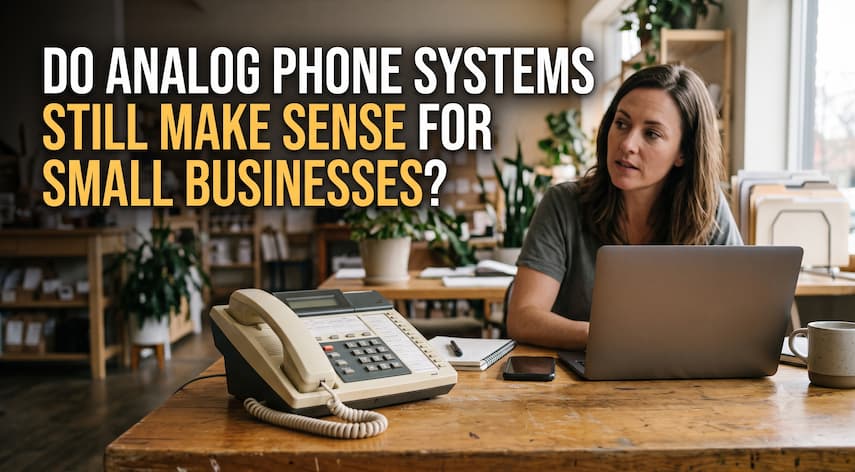
Plenty of small businesses still run on the same phone wiring that’s been in the wall since before smartphones existed. That’s not necessarily a problem — analog phone systems still work, and for some businesses, they work well. But knowing whether to keep one, upgrade it, or replace it entirely requires understanding what analog actually offers and where it falls short.
This guide breaks down how analog business phone systems work, what multi-line and PBX setups actually mean, how analog compares to VoIP and smartphones, and what should factor into the decision to keep, upgrade, or replace an existing system.
What Is an Analog Phone System?
An analog phone system carries voice as a continuous electrical signal over physical copper telephone lines, connecting a handset directly to the phone network without converting the call into digital data. It’s the same basic technology behind traditional home phone lines, adapted for business use with multiple lines or extensions.
The core pieces are simple: a physical line coming into the building from a telecom carrier, wiring distributing that connection to individual phones, and handsets that plug directly into jacks. There’s no internet connection required and no software platform to manage — the system works largely the same way it has for decades.
How Does an Analog Business Phone System Work?

An analog business phone system routes calls through physical telephone lines connected to handsets, sometimes through a piece of equipment called a PBX that manages multiple lines and extensions within an office. Calls travel over dedicated copper wiring rather than the internet.
In a simple setup, each phone line from the carrier connects to one handset. In a small office with multiple employees, a PBX unit sits between the incoming carrier lines and the office’s internal phones, letting several employees share a smaller number of external lines while still reaching each other through internal extensions. Wiring runs from the PBX to each desk, and adding a phone generally means running a new wire or using an existing jack.
Are Analog Phone Systems Still Suitable for Small Businesses?
Analog phone systems can still suit small businesses with stable, on-site teams, modest call volume, and no pressing need for advanced call routing or remote access. They tend to become less suitable as a business grows, adds remote staff, or needs features like call analytics and CRM integration.
A single-location retail shop or a small professional office with a handful of employees who all work on-site may find an analog system perfectly adequate, especially if it’s already installed and functioning. A business planning to add remote workers, multiple locations, or advanced call handling will likely hit analog’s limitations sooner rather than later. Neither situation makes analog universally right or wrong — it depends on how the business actually operates.
What Are Analog Multi-Line Phone Systems?
An analog multi-line phone system allows a small office to handle several incoming and outgoing calls at once by connecting multiple physical telephone lines to a shared set of handsets, with each line typically appearing as a selectable button on the phone itself.
This is different from extensions, which is a common point of confusion. A line is a physical connection to the outside phone network — if a business has three lines, three separate calls can happen simultaneously. An extension is an internal number used to reach a specific person or department, without necessarily corresponding to its own external line. A small office might have three incoming lines shared across ten employee extensions, letting anyone answer any of the three calls currently active. This setup works well for offices where staff regularly need to pick up whichever line is ringing, such as a small clinic or retail counter.
What Is an Analog PBX System for Small Business?
An analog PBX (Private Branch Exchange) is on-site equipment that manages a small business’s internal extensions and connects them to a limited number of external phone lines, letting employees call each other internally without using an outside line, while sharing external lines for outbound and inbound calls.
PBX is the switching system, not the handset — it sits between the incoming carrier lines and the office’s internal phones, directing calls to the right extension. An analog PBX handles this using physical wiring and traditional signaling, while a VoIP PBX performs the same switching function over an internet connection instead, generally with more built-in features like auto attendants and call queues managed through software rather than hardware.
What Should You Look for in the Best Analog Phone System for Small Business?
There’s no single best analog phone system — the right choice depends on how many users and lines a business needs, what call-handling features matter, how the system will be installed and maintained, and how much room there is to expand later. Evaluating options against these criteria matters more than any single product’s reputation.
Before choosing equipment, it helps to confirm the number of users and lines needed now and in the near future, check compatibility with existing wiring, review what call-handling features are actually built in versus optional, and ask about installation and ongoing maintenance requirements. Total cost, available support, and whether the system allows for future expansion or migration to VoIP are all worth weighing before committing to a specific setup. Businesses should verify compatibility and current specifications directly with the manufacturer or installer before purchasing.
Analog Phone Systems vs VoIP for Small Business

Analog phone systems rely on physical lines and offer straightforward, familiar operation, while VoIP systems run over the internet and generally offer easier scaling, more built-in features, and better support for remote work — though VoIP call quality depends on a reliable internet connection.
Analog tends to hold up well in situations where the phone system needs to keep working regardless of internet or power issues, and where advanced features aren’t a priority. VoIP is generally the more practical choice for businesses that expect to grow, need to support remote or hybrid staff, or want integrations with other business software. Cosmetic Smile Guide readers researching phone systems more broadly may find the fuller comparison in Business Phone Systems: How to Choose the Right One useful for weighing analog against the full range of modern alternatives, including cloud-hosted systems, which tend to scale with a growing business more easily than adding new analog lines and wiring.
| Factor | Analog | VoIP |
|---|---|---|
| Infrastructure | Physical copper lines | Internet connection |
| Scalability | Limited, requires new wiring | Generally easier, software-based |
| Remote work support | Limited | Strong |
| Advanced features | Basic, hardware-dependent | Often built in |
| Reliability during internet outage | Unaffected | Vulnerable without backup |
| Maintenance | Physical technician visits | Often self-service |
Analog Phone System vs Smartphone for Business Use
A dedicated analog phone system offers shared lines, internal extensions, and centralized call handling that a smartphone alone doesn’t provide, while a smartphone for business use offers mobility and lower upfront cost but limited ability to share calls, manage extensions, or route calls the way a multi-line office system can.
Neither is automatically better. A solo entrepreneur or a very small team without a physical office may do fine relying on smartphones with a business number app, avoiding the cost of installing a dedicated system entirely. A business with several employees who need to share incoming calls, transfer between departments, or maintain a professional main number is likely better served by a proper phone system — analog, VoIP, or hybrid — since coordinating call handling across multiple personal smartphones tends to become unwieldy as a team grows.
Advantages of Analog Phone Systems
Analog phone systems offer genuine advantages in familiarity, simplicity, and independence from internet reliability — the equipment is straightforward to operate, doesn’t require ongoing software updates, and keeps working during internet or power outages if the lines themselves stay active.
For businesses in areas with inconsistent internet service, or those that simply want a phone that works without configuration, analog remains a reasonable choice. Existing analog infrastructure that’s already installed and functioning also represents a sunk cost advantage — replacing a working system carries its own expense and disruption that needs to be weighed against any benefits of switching.
Limitations of Analog Phone Systems
Analog phone systems are limited in advanced call-handling features, harder to scale as a business grows, generally unable to support remote employees without additional workarounds, and dependent on physical hardware that requires on-site maintenance and wiring changes to expand.
Features like auto attendants, call queues, voicemail-to-email, and CRM integration are either unavailable on analog systems or require additional equipment that adds cost and complexity. Adding a new line or extension usually means a technician visit and new wiring, rather than a quick software change. These limitations don’t affect every business equally — a stable, on-site team may never notice them, while a growing or increasingly remote team is more likely to run into real constraints.
How Much Does an Analog Business Phone System Cost?
The cost of an analog business phone system depends on the number of lines and handsets needed, whether a PBX unit is required, installation and wiring costs, and ongoing carrier line charges — there’s no single fixed price, and current costs should be verified directly with equipment vendors and carriers.
Beyond the phones and PBX hardware itself, businesses should budget for installation and wiring, ongoing monthly line charges from the carrier, occasional maintenance or repair visits, and eventual hardware replacement as equipment ages. Expanding the system later, whether adding lines or extensions, typically carries its own installation cost rather than being a simple software update. All pricing should be confirmed directly with vendors, since equipment and carrier costs vary by region and provider.
Who Should Consider an Analog Phone System?
Analog phone systems tend to suit small, single-location businesses with stable staffing, modest call volume, and no near-term need for remote work support or advanced call routing — particularly where a working analog system is already in place.
Retail counters, small clinics, and professional offices with a handful of on-site employees are common examples where analog continues to serve businesses well. A new business setting up communications from scratch, especially one expecting growth or remote staff, has less reason to start with analog given the flexibility modern alternatives offer.
When Should a Small Business Consider Switching Away From Analog?
A small business should consider switching away from analog when it adds remote or hybrid staff, needs advanced call routing or CRM integration, is growing quickly enough that adding lines becomes frequent and costly, or is dealing with aging infrastructure that’s increasingly expensive to maintain.
These signals don’t mean every business must switch immediately, but they’re worth treating as a prompt to reassess. A business modernizing several parts of its operations at once may find it useful to sequence a phone system upgrade alongside other technology decisions — Cosmetic Smile Guide’s broader 90-day technology roadmap for small businesses offers a useful framework for planning this kind of transition alongside other upgrades rather than in isolation.
How to Choose the Right Business Phone System

Choosing the right system, whether analog, VoIP, or hybrid, works best as a structured process:
- Count current and near-term future users and lines.
- List the call-handling features actually needed, not just nice-to-have ones.
- Assess internet reliability if VoIP is being considered.
- Estimate total cost, including hardware, installation, and ongoing fees.
- Check compatibility with any existing wiring or equipment.
- Consider remote or hybrid work needs now and in the near future.
- Ask about maintenance, support, and expansion options.
- Weigh the cost and disruption of switching against the limitations of staying put.
Working through this list clarifies whether keeping, upgrading, or replacing an existing analog setup is the more sensible move for a specific business, rather than defaulting to whichever option seems newest or most familiar.
Frequently Asked Questions
What is an analog phone system?
An analog phone system carries voice calls as continuous electrical signals over physical copper telephone lines, connecting handsets directly to the phone network without converting calls into digital data.
Are analog phone systems still used by small businesses?
Yes, many small businesses, especially those with stable on-site teams and modest call volume, still use analog systems, often because existing infrastructure already works reliably.
What is an analog business phone system?
It’s an analog setup adapted for office use, typically involving multiple phone lines, handsets, and sometimes a PBX unit that manages internal extensions alongside external calls.
What is an analog PBX system?
An analog PBX is on-site equipment that connects internal extensions to a limited number of external phone lines, letting employees call each other internally while sharing outside lines for external calls.
Can an analog phone system support multiple lines?
Yes, multi-line analog systems let a business handle several calls simultaneously by connecting multiple physical lines to a shared set of handsets, common in small offices and retail settings.
What is the difference between analog and VoIP phone systems?
Analog systems use physical copper lines and don’t need internet access, while VoIP systems send calls over the internet and generally offer easier scaling and more built-in features, at the cost of internet dependency.
Are analog phone systems cheaper than VoIP?
Not necessarily — analog can have lower ongoing software costs but higher expansion and maintenance costs, while VoIP often has lower upfront hardware costs but recurring per-user fees. Total cost depends on business size and needs.
Can I use a smartphone for business instead of a phone system?
For solo entrepreneurs or very small teams without a physical office, yes. Businesses needing shared lines, extensions, or centralized call handling generally need a dedicated system instead.
What should I look for in an analog phone system?
Look at the number of users and lines needed, required call-handling features, installation and maintenance requirements, and room for future expansion, rather than choosing based on a single “best” label.
When should a small business replace an analog phone system?
Consider replacing it when adding remote staff, needing advanced call routing or CRM integration, facing frequent and costly line additions, or dealing with aging infrastructure that’s hard to maintain.
Conclusion
Analog phone systems aren’t obsolete, and they aren’t automatically the safe choice either — the right answer depends on how a specific business operates today and where it’s headed. A stable, on-site team with modest call needs may do just fine sticking with analog, while a growing or increasingly remote business will likely find VoIP or a hybrid setup better suited to where things are going.
Working through the decision framework above — infrastructure, call volume, growth plans, and budget — gives a clearer answer than simply assuming newer technology is always better. Compare available business phone options against your specific situation, and evaluate your current infrastructure honestly before deciding whether to keep, upgrade, or replace it.

Mike Farrier is a seasoned technology journalist, digital trends researcher, and Senior Editor at Queknow. With over a decade of hands-on experience spanning web architecture, emerging tech, digital consumer products, and data-driven market insights, Mike bridges the gap between complex topics and actionable knowledge. He leads the editorial team to deliver rigorously fact-checked, up-to-date guides and comprehensive analysis across digital lifestyle, enterprise technology, and online business ecosystems. When not analyzing industry shifts, Mike actively tests consumer software and contributes to tech forums.
Recommended For You

Choosing a business phone system used to mean picking a landline provider and installing desk phones. Today, businesses can choose

Fulfillment feels manageable at low order volume. A handful of staff can pick, pack, and ship orders by hand without

Freelancing comes with a version of bookkeeping most employees never have to think about: tracking your own income, categorizing your