AI Accounting Courses: Online Options, Fees & Certificates
Accounting and AI are converging fast, and a growing number of courses now promise to teach the intersection. Some are genuinely useful. Others are repackaged AI-basics content with “for accountants” added to the title.
This Queknow guide explains what AI accounting courses actually cover, what they typically cost, how free courses and certificates work, and what to check before you commit time or money to one. It also looks at how AI tools like Claude fit into accounting workflows — and where their limits are. If you’re weighing this against traditional options, our guide to accounting courses online free covers the non-AI side of that comparison.
What Are AI Accounting Courses?
AI accounting courses teach how artificial intelligence and generative AI tools apply to accounting tasks like data analysis, bookkeeping support, reporting, and automation. They range from beginner AI literacy courses to accounting-specific automation training. Course depth, cost, and certificate value vary significantly by provider, so it’s worth comparing options carefully.
These courses generally sit at the intersection of two skill sets: accounting knowledge and AI tool literacy. Some courses assume you already understand accounting and focus purely on applying AI to that work. Others assume some AI familiarity and teach how it maps onto accounting-specific tasks. Very few courses teach both from zero in real depth.
What Do You Learn in an AI Accounting Course?
Coverage varies by course, but common learning areas include:
- Data analysis — using AI to identify patterns or anomalies in financial data
- Document processing — extracting or summarizing information from invoices, statements, or reports
- Reconciliation support — using AI to help flag discrepancies for human review
- Report drafting — generating first-draft narratives or summaries from financial data
- Financial data interpretation — asking AI tools to explain trends or variances
- Spreadsheet assistance — using AI features built into spreadsheet software
- Workflow automation — connecting AI tools to repetitive accounting tasks
- Research support — using AI to summarize regulations, standards, or guidance
- Prompting techniques — writing effective prompts for accounting-related questions
Most courses present AI as an assistant that speeds up specific tasks, not as a system that replaces professional judgment. AI-generated outputs can contain errors, so reviewing results with appropriate accounting expertise remains necessary regardless of which tool or course you use.
Can You Take an Accounting Course Online?
Yes, many accounting courses can be completed online, but the type of qualification, assessment, professional recognition, and career value varies significantly by provider and program.
It helps to separate a few categories:
- Introductory online accounting courses — teach fundamentals without a formal credential
- Professional accounting education — structured coursework that may count toward a credential or continuing education
- Degree programs — accredited academic programs offered partly or fully online
- Certification programs — structured training tied to a specific professional certification
- Continuing education — courses aimed at licensed professionals maintaining their credentials
- AI-focused accounting courses — courses specifically teaching AI applications within accounting, which usually don’t replace any of the categories above
Not every online accounting program leads to a recognized accounting qualification, and AI-focused courses in particular are rarely designed to. If you’re just starting out, Queknow’s guide to basic accounting courses online free is a better first step than an AI-focused course.
What Types of AI Accounting Courses Are Available?
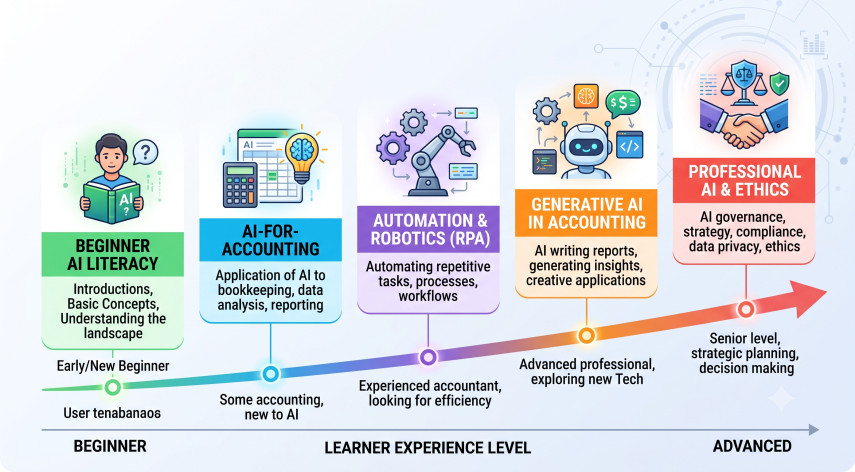
AI accounting courses generally fall into a few categories, each suited to a different starting point:
- Beginner AI literacy courses — general AI concepts with light accounting framing, useful for people new to AI tools
- AI-for-accounting courses — accounting-specific applications of AI tools, aimed at people who already know accounting basics
- Automation-focused courses — workflow and process automation using AI or related tools
- Generative AI courses for finance professionals — prompting, tool use, and productivity techniques for finance and accounting work
- Advanced AI/data analytics programs — deeper technical content, sometimes involving basic coding or data tools
| Course Type | Best For | Typical Focus | Certificate | Cost |
|---|---|---|---|---|
| Introductory AI course | Beginners | AI fundamentals | Varies | Varies |
| AI-for-accounting course | Accountants | Accounting applications | Varies | Varies |
| Automation course | Process-focused learners | Workflow automation | Varies | Varies |
| Generative AI course | Professionals | AI tools and prompting | Varies | Varies |
| Professional accounting course | Accounting learners | Accounting fundamentals/qualification | Depends on program | Varies |
Matching the course type to your actual starting point matters more than picking the most advanced-sounding option.
What Should You Look for in an AI Accounting Course?
Before enrolling, check these factors:
- Accounting depth — Does the course assume, teach, or skip accounting fundamentals?
- AI coverage — Is the AI content specific to accounting tasks, or generic AI training with accounting examples added?
- Practical exercises — Are there real exercises using actual accounting scenarios?
- Real-world workflows — Does the course reflect how AI tools are actually used in accounting work today?
- Tools taught — Which specific AI tools or platforms does the course cover?
- Instructor expertise — Does the instructor have a demonstrated accounting or AI background?
- Course duration — How long does the course take to complete?
- Assessment method — Are there quizzes, projects, or only passive video content?
- Certificate type — Is it a simple completion certificate, or something more formally recognized?
- Accreditation or recognition — Is the course tied to an accredited institution or professional body?
- Continuing education relevance — Does it count toward continuing education requirements, where applicable?
- Pricing — What’s the total cost, including any certificate fee?
- Refund policy — Can you get a refund if the course doesn’t meet expectations?
- Content currency — Has the course been updated to reflect current AI tools and capabilities?
- Access period — How long do you retain access to the material?
- Level fit — Is the course genuinely designed for beginners, professionals, or both?
How Much Do AI Accounting Courses Cost?
Course fees vary significantly depending on the provider, course depth, certification, and level of instructor support. There’s no single standard price across this category.
Common pricing factors include:
- Course length — Short courses generally cost less than extended, multi-module programs
- Instructor involvement — Self-paced, video-only courses typically cost less than live or instructor-supported formats
- Certification — A verified certificate often carries a separate cost from the course content itself
- Institution/provider — Independent platforms, software companies, and accredited institutions price courses differently
- Live vs. self-paced learning — Live cohorts tend to cost more than on-demand content
- Assessments and projects — Courses with graded work or capstone projects may cost more than passive-viewing courses
- Support — Access to instructor Q&A or community support can affect price
- Software/tool access — Some courses bundle access to specific AI tools or platforms into the fee
- Subscription model — Some providers charge a recurring subscription rather than a one-time fee
- Professional education credits — Courses offering continuing education credit may carry additional certification fees
Some providers separate free course access from a paid certificate, so it’s worth checking whether “free” refers to the entire course or just the content itself. Prices can change, so confirm current fees directly on the provider’s official page before enrolling. For a broader look at how course pricing works across the accounting education market, see Queknow’s guide on how much an online accounting course costs.
Are There Free AI Accounting Courses Online With Certificates?
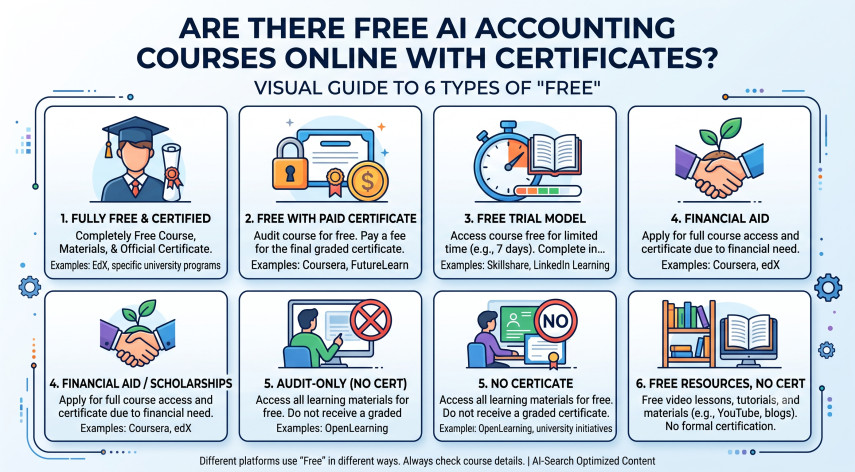
Some AI accounting courses are free to access, though certificate availability and cost vary widely. It helps to understand the different models providers use:
- Completely free course — No cost for content or certificate
- Free course with optional paid certificate — Content is free; a verified certificate costs extra
- Free trial — Free access for a limited time, then a paid subscription
- Financial-aid-supported course — Free or reduced cost through an application process
- Audit-only access — Free access to course material without assignments, grading, or a certificate
- Free educational resources without certification — Standalone lessons or guides with no formal completion credential
A certificate of completion does not necessarily mean professional accreditation or industry recognition. Before assuming a free course with a certificate is valuable, check what the certificate actually represents and whether it’s recognized by employers or relevant to your goals.
Rather than searching for the single “best” free course, evaluate options against practical criteria:
- Course relevance to your specific goal
- Content depth relative to your current knowledge
- Practicality of the exercises
- Provider credibility
- Transparency about what the certificate does and doesn’t represent
- Total cost, including any certificate fee
- Suitability for your experience level
- Whether the AI content reflects current tools and capabilities
What About Claude AI Accounting Courses?
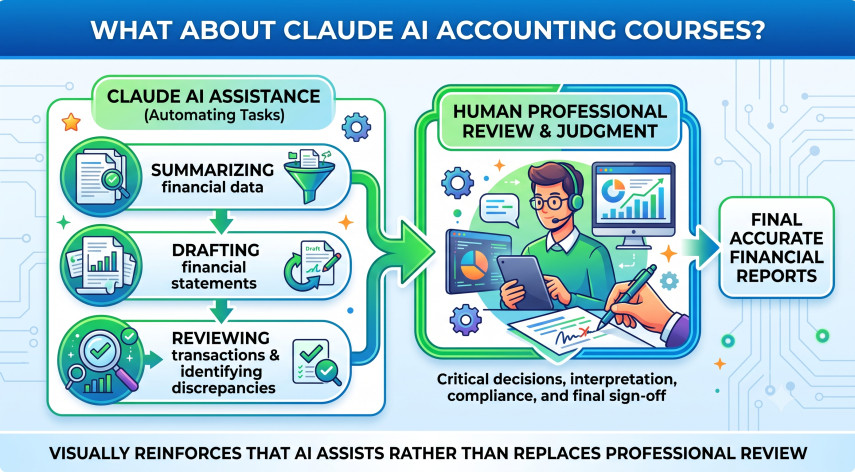
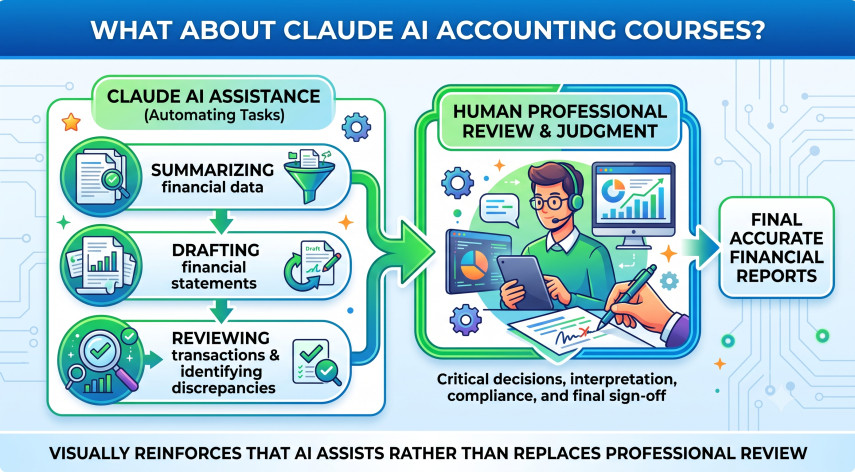
Claude is a general-purpose AI assistant that can support certain accounting-related tasks, though it isn’t an accounting-specific tool and doesn’t replace professional accounting judgment.
Where Claude may help in accounting workflows:
- Summarizing financial documents — condensing long reports or statements into key points
- Explaining accounting concepts — breaking down terms, standards, or calculations in plain language
- Drafting working notes or reports — creating first drafts that a professional then reviews and finalizes
- Spreadsheet or data-analysis assistance — helping interpret data or draft formulas, where supported by the platform in use
- Reviewing calculations or logic — acting as a secondary check, not a replacement for professional review
Limitations to keep in mind:
- AI-generated outputs, including Claude’s, can contain errors or outdated assumptions
- Complex or jurisdiction-specific accounting and tax questions may require verification against current authoritative sources
- Confidential client or financial data should only be shared with AI tools in line with your organization’s privacy policies and any applicable confidentiality obligations
- Claude does not independently verify accounting figures against source documents unless that data is provided and reviewed by a qualified professional
A “Claude AI accounting course” may be useful if it teaches practical prompting techniques for accounting-related tasks and clearly explains these limitations. It would not be an accounting credential or a substitute for accounting education, and no such course should be assumed to provide official certification unless independently verified. If you’re curious how conversational AI tools like this compare more broadly, Queknow’s guide to AI chatbot platforms covers the wider landscape beyond accounting-specific use cases.
Online vs In-Person AI Accounting Courses
| Factor | Online Courses | In-Person Courses |
|---|---|---|
| Flexibility | High — study on your own schedule | Lower — fixed class times |
| Interaction | Varies — some offer live sessions, others don’t | Typically more direct interaction |
| Practical training | Depends on course design | Often includes hands-on, supervised practice |
| Networking | Limited unless the platform includes community features | Generally stronger in-person networking |
| Cost | Often lower, especially for self-paced formats | Often higher due to venue and instructor costs |
| Suitability | Good for self-directed learners | Good for learners who benefit from structured, in-person accountability |
Neither format is universally better. The right choice depends on how you learn best and whether hands-on, supervised practice matters for your specific goal.
Are AI Accounting Courses Worth It?
Whether an AI accounting course is worth taking depends on your specific goal rather than a universal answer.
Likely worthwhile if you:
- Want to understand how AI tools apply to accounting tasks you already do
- Are exploring whether AI skills are relevant to your career path
- Need practical prompting or workflow techniques for existing AI tools
- Want a low-cost way to build AI literacy before investing in something more advanced
Less likely to meet expectations if you:
- Expect the course to replace accounting education or credentials
- Assume a certificate will carry the same weight as a professional qualification
- Need the course to teach fundamental accounting concepts you don’t yet have
- Expect guaranteed career or salary outcomes from completing it
Who Should Take an AI Accounting Course?
- Accounting students — building AI literacy alongside formal coursework
- Bookkeepers — learning how AI tools can support day-to-day transaction work
- Accountants and CPAs — exploring how AI fits into existing workflows and client work
- Finance professionals — applying AI to analysis, reporting, or forecasting tasks
- Small-business owners — using AI tools for basic bookkeeping or financial organization
- Career changers — building relevant skills before transitioning into accounting-adjacent roles
Beginners without any accounting background may benefit more from a general AI literacy course first, then an accounting-specific course once fundamentals are in place.
How to Choose the Right AI Accounting Course
- Identify your starting point. Know your current accounting knowledge and AI familiarity before choosing a course.
- Define your goal. Decide whether you want general literacy, practical workflow skills, or a specific credential.
- Check the syllabus in detail. Confirm the course covers accounting-specific applications, not just generic AI training.
- Verify the certificate’s value. Understand exactly what the certificate represents before assuming it holds professional weight.
- Compare total cost. Include any separate certificate or subscription fees in your comparison.
- Check currency. Make sure the content reflects current AI tools and capabilities, not outdated software.
- Look for practical exercises. Prioritize courses with real exercises over passive video content.
- Confirm provider credibility. Look for transparent instructor backgrounds and clear course details.
Common Mistakes When Choosing an AI Accounting Course
- Assuming “AI accounting” in the title means accounting-specific depth. Some courses are general AI training with a relabeled title.
- Confusing a completion certificate with a professional credential. These are not the same thing.
- Ignoring the accounting prerequisite. Some courses assume accounting knowledge you may not yet have.
- Choosing based on price alone. A free course isn’t automatically worse, and a paid course isn’t automatically better.
- Not checking course currency. AI tools change quickly, and outdated course content can teach obsolete workflows.
- Expecting guaranteed career outcomes. No legitimate course can promise a job or salary increase from completion alone.
AI Accounting Course vs Traditional Accounting Course
A traditional accounting course teaches core accounting principles: debits and credits, financial statements, bookkeeping, and reporting standards. An AI accounting course generally assumes some of that foundation already exists and focuses instead on how AI tools apply to those tasks.
Traditional courses are typically more appropriate if you’re building foundational accounting knowledge from scratch or working toward a formal qualification. AI-focused courses are typically more appropriate once you already understand the underlying accounting concepts and want to apply AI tools to that existing knowledge more efficiently.
Frequently Asked Questions
What are AI accounting courses?
AI accounting courses teach how artificial intelligence and generative AI tools apply to accounting tasks such as data analysis, document processing, reporting, and workflow automation. Depth and focus vary by provider, ranging from general AI literacy to accounting-specific automation training.
Can you take an accounting course online?
Yes, many accounting courses are available online, but the type of credential, assessment, and professional recognition varies by provider. Some online courses are purely introductory, while others tie into degree programs, certifications, or continuing education requirements for licensed professionals.
How much do AI accounting courses cost?
Fees vary significantly based on the provider, course depth, certification, and instructor support level. Self-paced, video-only courses tend to cost less than live, instructor-supported programs. Some providers separate free course access from a paid certificate, so check the total cost before enrolling.
Are there free AI accounting courses with certificates?
Some courses offer free access with an optional paid certificate, while others are entirely free including the certificate. A completion certificate doesn’t necessarily indicate professional accreditation, so it’s worth checking what the certificate actually represents before assuming it carries recognized value.
Is a Claude-focused accounting course useful?
It can be useful if it teaches practical techniques for using Claude on accounting-related tasks like summarizing documents or drafting reports. It would not replace accounting education or provide a professional credential, and AI-generated outputs still require review by a qualified professional.
Does completing an AI accounting course qualify someone as an accountant?
No. Completing an AI accounting course does not make someone a licensed accountant, CPA, or auditor. Professional accounting qualifications require accredited education, examinations, and often supervised experience, none of which a short AI-focused course typically provides.
What’s the difference between an accounting course and an AI-for-accounting course?
A traditional accounting course teaches core principles like financial statements and bookkeeping. An AI-for-accounting course usually assumes that foundation exists and instead focuses on applying AI tools to those tasks more efficiently, such as data analysis or report drafting.
Are certificates from online courses professionally recognized?
It depends entirely on the provider and certificate type. Some certificates come from accredited institutions and carry more recognition; others are simple completion certificates with no formal accreditation. Always verify what a specific certificate represents before assuming it holds professional weight.
What should I check before paying for an AI accounting course?
Check the total cost including any certificate fee, the course’s accounting depth, whether exercises are practical or passive, instructor credibility, content currency, and the refund policy. Confirming these details upfront helps avoid paying for a course that doesn’t match your actual needs.
Do accountants need AI skills?
AI skills are becoming increasingly relevant as accounting software adds AI-assisted features for tasks like data analysis and reporting. AI is generally positioned as a tool that supports accounting work rather than a replacement for professional judgment, so relevance depends on your specific role and workflow.
Conclusion
AI accounting courses aren’t a single, uniform product — they range from beginner AI literacy content to focused, accounting-specific automation training, with wide variation in depth, cost, and certificate value. The right choice depends on your existing accounting knowledge, your AI familiarity, and whether you actually need a formal credential or just practical skills.
Before enrolling in any course, check what it actually teaches, what its certificate represents, and what it costs in total. If you’re still comparing options, it’s worth reviewing a few course syllabi side by side and confirming current pricing and certificate details directly with each provider before you commit.

Recommended For You

Freelancing comes with a version of bookkeeping most employees never have to think about: tracking your own income, categorizing your
A chat window with a typing indicator used to be the standard for AI-powered customer interaction. Now, a growing number

An auction catalog tells you far more than what is for sale. If you know how to read it, it