How Much Is an Online Accounting Course?

“Online accounting course” can mean very different things depending on who’s offering it. A short self-paced course teaching basic bookkeeping is a different product — and a different price — than a college-level accounting certificate or a full online accounting degree.
That difference matters when you’re trying to budget. This Queknow guide breaks down what actually drives the cost of online accounting education, how courses compare to certificates and degrees, and what to check before you enroll in anything. If you haven’t ruled out free options yet, it’s worth first reading our overview of accounting courses online free before comparing paid programs.
How Much Is an Online Accounting Course?
There’s no single price for an online accounting course, since cost depends on the provider, course length, instructor support, and credential offered. Short skill-based courses often cost far less than certificate programs, while full accounting degrees involve tuition, fees, and materials that add up to a much larger total investment.
Rather than quote one number, it helps to understand what pushes price up or down. A short, self-paced video course focused on a single topic — like reading financial statements — typically sits at the lower end of the cost spectrum. A course that includes instructor feedback, graded assignments, and a completion credential usually costs more. Anything issued through an accredited college, even a short course, tends to cost more than something from an independent instructor or platform.
What Determines the Cost of an Online Accounting Course?
Several factors explain why one course might cost noticeably more than another covering similar material.
- Course length — A two-hour video series costs less to produce and price than a multi-week program.
- Provider type — Independent instructors, ed-tech platforms, and accredited colleges price courses differently based on overhead and credentialing.
- Instructor support — Courses with live Q&A, graded feedback, or office hours typically cost more than self-paced, video-only formats.
- Self-paced vs. instructor-led format — Instructor-led cohorts generally carry a higher price than fully self-paced options.
- Credential offered — A course ending in a verified certificate usually costs more than one with no credential at all.
- Included materials — Textbooks, templates, or software access can be bundled into the price or charged separately.
- Exams — Courses that include proctored exams or formal assessments may carry additional fees.
- Technology or platform fees — Some providers charge separately for platform access beyond the course content itself.
- Accreditation or institutional status — Courses tied to an accredited institution tend to cost more than those from unaccredited platforms, partly reflecting the added recognition.
Comparing two courses on price alone, without checking these factors, can be misleading.
How Much Is an Online Bookkeeping Course?
Bookkeeping courses and accounting courses aren’t automatically priced the same way, even though the subjects overlap. Bookkeeping courses tend to focus more narrowly on recording transactions, reconciling accounts, and using accounting software, while broader accounting courses may cover financial analysis and reporting concepts as well.
Pricing for bookkeeping courses varies based on:
- Length — A short bookkeeping fundamentals course costs less than an extended program covering multiple software platforms
- Depth — Courses that go beyond basics into payroll, tax-adjacent topics, or advanced reconciliation typically cost more
- Format — Self-paced video content is usually priced lower than live, instructor-led training
- Credential — A course offering a recognized completion certificate may carry a higher price than one without
- Provider — Software companies, community colleges, and independent educators all price bookkeeping training differently
- Career objective — Courses designed to prepare someone for a bookkeeping job may include more practical assessment, which can affect price
If your goal is specifically bookkeeping rather than broader accounting knowledge, comparing bookkeeping-specific courses directly — rather than general accounting courses — will give you a more accurate sense of realistic pricing for your goal. If cost is a major concern, it’s worth checking Queknow’s guide to basic accounting courses online free before committing to a paid bookkeeping course.
How Much Does an Accounting Certificate Cost?
An accounting certificate program sits a step above an individual course in both scope and typically in price. Certificate programs are usually structured, multi-course sequences offered through a college, university, or recognized training provider, often resulting in a more formal credential than a single course completion certificate.
Accounting certificate pricing can be influenced by:
- Number of required courses or credits — More credits generally means a higher total cost
- Institution type — Community colleges, universities, and private training providers price certificate programs differently
- In-state vs. out-of-state status — Public institutions may charge different rates depending on residency, where applicable
- Program format — Fully online, hybrid, and in-person-equivalent online formats can carry different fee structures
- Included resources — Some certificate programs bundle textbooks, software access, or academic advising into the price
- Accreditation — Certificates from accredited institutions may cost more but can carry more recognition with employers
Because certificate programs vary so much in structure, checking the total program cost — not just a per-course estimate — gives a clearer financial picture than comparing single course prices.
How Much Is an Online Accounting Degree?
Online accounting degree costs vary more than almost any other category in this comparison, because degree programs differ by institution, degree level, and credit requirements.
Cost typically depends on:
- Institution — Public universities, private universities, and community colleges (for associate degrees) have different tuition structures
- Degree level — Associate degrees generally require fewer credits than bachelor’s degrees, which affects total cost
- Number of credits required — Total tuition is usually calculated per credit hour, multiplied by the credits needed to graduate
- Residency policies — Some public institutions charge different tuition rates for in-state and out-of-state students, even in online programs; policies vary by school
- Transfer credits — Credits transferred from prior coursework can reduce the number of credits — and therefore the cost — required to complete the degree
- Fees — Technology fees, student services fees, and other institutional charges are often added on top of tuition
- Financial aid — Federal aid, scholarships, and institutional aid can reduce the amount a student ultimately pays out of pocket
Because these variables differ so much by school, the most reliable way to get an accurate cost is to check the official tuition and fee schedule published by each specific institution you’re considering, along with resources from Federal Student Aid for aid eligibility.
Course vs. Certificate vs. Degree: How Do the Costs Compare?
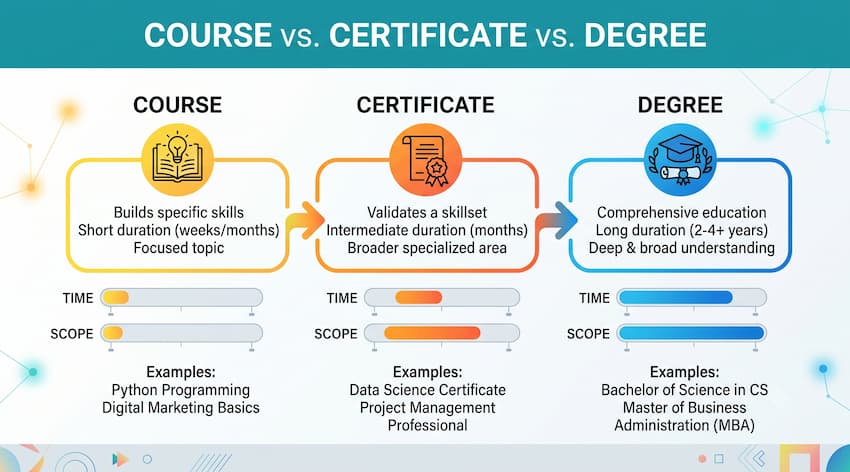
| Option | Typical Purpose | Study Length | Cost Factors | Credential |
|---|---|---|---|---|
| Online accounting course | Skill development or focused learning | Varies — hours to a few weeks | Provider, duration, instructor support | Course completion (informal) |
| Online bookkeeping course | Bookkeeping-specific skills | Varies — hours to a few weeks | Provider, format, curriculum depth | Course completion, sometimes a certificate |
| Accounting certificate | Structured, multi-course credential | Weeks to about a year, depending on the program | Institution, number of credits, format | Certificate |
| Accounting degree | Formal higher education | Roughly 2 years (associate) to 4 years (bachelor’s) | Institution, credits, fees, financial aid | Degree |
This table reflects general patterns across the education landscape rather than specific prices, since actual costs depend on the provider or institution you choose.
What Does an Online Accounting Degree Cost Beyond Tuition?
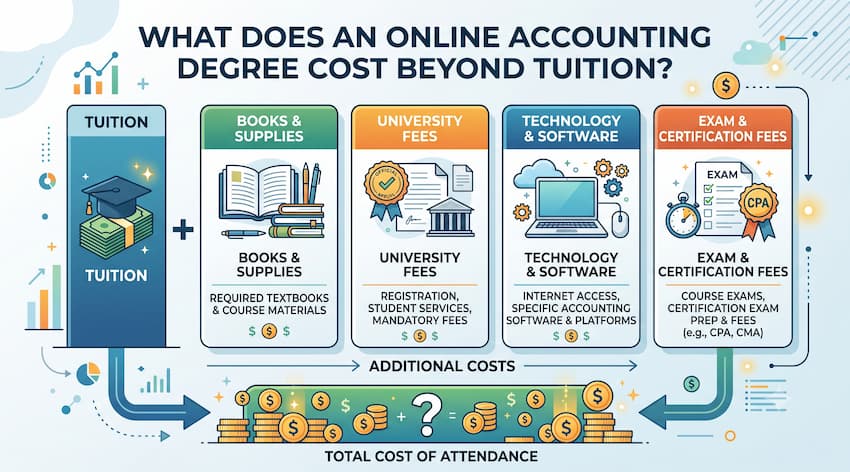
Tuition is usually the headline number, but it’s rarely the full cost of an accounting degree. Additional expenses to plan for include:
- Books and course materials — Textbooks and required software can add a meaningful amount per term
- Technology fees — Many online programs charge a separate fee to cover the learning platform
- Application fees — A one-time cost to apply, which varies by institution
- Exam fees — Some programs charge separately for proctored exams
- Student fees — General institutional fees that apply regardless of enrollment format
- Other charges — Graduation fees, transcript fees, or program-specific charges some institutions apply
Asking for a complete, itemized cost breakdown from each institution — not just the advertised tuition rate — gives a far more accurate picture of what a degree will actually cost.
How to Get an Online Accounting Degree
While the exact process differs by institution, most students follow a similar general path:
- Research programs. Compare accounting degree options from accredited institutions offering online formats.
- Check admission requirements. Review prerequisites, required test scores (if any), and application deadlines.
- Compare accreditation and institutional recognition. Confirm the program’s accreditation status before applying.
- Review the curriculum. Check whether required courses align with your academic or career goals.
- Check total tuition and fees. Request a complete cost breakdown, not just the per-credit tuition rate.
- Investigate financial aid. Look into federal aid, scholarships, and institutional aid options.
- Apply. Submit the institution’s application along with any required materials.
- Complete required coursework. Progress through the program’s required and elective courses.
- Meet graduation requirements. Confirm you’ve satisfied all credit and academic requirements before graduation.
Every institution structures its own admissions and program requirements, so confirming specifics directly with each school is an important step before enrolling.
How to Compare Online Accounting Programs by Cost
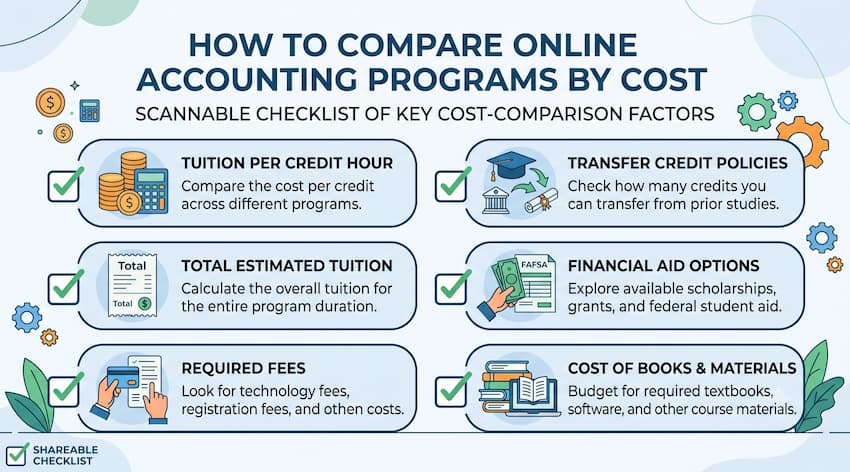
Comparing programs by advertised tuition alone often leads to inaccurate conclusions. A more reliable comparison looks at:
- Total program cost — The full cost from start to finish, not just per-term tuition
- Cost per credit — Useful for comparing programs with different credit requirements
- Number of credits required — Programs with more required credits may cost more overall, even at a lower per-credit rate
- Mandatory fees — Technology, student services, and other fees that apply regardless of financial aid
- Program length — Longer programs may cost more in total, even if the monthly cost feels lower
- Transfer-credit policies — How many credits, if any, a program will accept from prior coursework
- Financial aid availability — What federal, state, or institutional aid may apply
- Included resources — Whether books, software, or advising are bundled into the cost
- Credential value — Whether the resulting credential aligns with your career or academic goals
- Accreditation — Whether the program is accredited by a recognized accrediting body
- Career relevance — Whether the program’s focus matches what you actually want to do afterward
Is a Cheaper Online Accounting Course Always Better?
Not necessarily. A lower price can reflect real savings, but it can also reflect less instructor support, a narrower curriculum, or no meaningful credential at the end.
Before assuming a cheaper option is the better deal, consider:
- Whether the course covers the depth you actually need
- Whether a completion certificate — if offered — carries any real recognition
- Whether the format (self-paced vs. instructor-led) matches how you learn best
- Whether hidden fees might make an initially cheap course cost more later
- Whether the course actually supports your specific goal, such as a job application or further study
A more expensive program isn’t automatically better either. The right choice depends on matching the program’s cost and depth to what you’re actually trying to accomplish.
Questions to Ask Before Paying for an Online Accounting Program
- What is the total cost, including all mandatory fees?
- Are there additional costs for materials, software, or exams?
- What credential will I receive at the end?
- Is the institution or program appropriately accredited or recognized?
- How long does completion typically take?
- Are transfer credits accepted, and how many?
- What financial aid options are available, and how do I apply?
- What happens if I need to pause my studies or withdraw?
- What career or educational pathway does this credential actually support?
Which Online Accounting Option Is Right for You?
The right option depends on your specific goal rather than a fixed rule:
- Want to learn one specific skill (like reading financial statements) → A short, focused course is often sufficient, and Queknow’s AI accounting courses guide covers a similar skill-based option worth comparing
- Want to build practical bookkeeping skills → A bookkeeping-specific course may better match your goal than a general accounting course
- Want a structured, recognized credential without a full degree → An accounting certificate program may fit
- Want broader academic credentials or are working toward a longer-term career goal, including a CPA pathway → A degree program is typically the more relevant option, and eventually connects to the kind of tools covered in Queknow’s CPA accounting software guide
If CPA licensure is part of your long-term plan, keep in mind that education and experience requirements vary by state. Check current requirements directly with the applicable state board of accountancy before choosing a program based on CPA eligibility assumptions.
Frequently Asked Questions
How much is an online accounting course?
Pricing varies widely based on the provider, course length, instructor support, and whether a credential is included. Short, self-paced courses tend to cost less than instructor-led courses or those offered through an accredited institution. Comparing total cost, not just the sticker price, gives a more accurate picture.
How much is an online bookkeeping course?
Bookkeeping course pricing depends on length, depth, format, and provider. A basic bookkeeping fundamentals course is generally priced lower than an extended program covering multiple software platforms or including a formal credential. Comparing bookkeeping-specific courses directly gives a more accurate estimate than comparing general accounting courses.
How much does an accounting certificate cost?
Certificate program cost depends on the number of required courses or credits, the institution offering it, and whether the program includes bundled resources like textbooks or software. Community colleges, universities, and private providers all price certificate programs differently, so checking total program cost is more reliable than a single course estimate.
How much does an online accounting degree cost?
Degree costs vary significantly based on the institution, degree level, number of required credits, and applicable fees. Associate degrees typically require fewer credits than bachelor’s degrees, which affects total cost. Checking a specific institution’s published tuition and fee schedule is the most reliable way to get an accurate number.
What’s the difference between an accounting course and an accounting certificate?
An accounting course is typically a single, focused learning experience covering a specific topic. An accounting certificate is usually a structured, multi-course program offered through an institution, often resulting in a more formal, recognized credential than a single course’s completion certificate.
How do you get an online accounting degree?
The general path includes researching accredited programs, reviewing admission requirements, comparing total tuition and fees, applying for financial aid, submitting an application, and completing the required coursework. Specific steps and requirements vary by institution, so confirming details directly with each school is recommended.
Is a cheaper online accounting course always better?
Not necessarily. A lower price can reflect genuine savings, but it can also mean less instructor support, a narrower curriculum, or no meaningful credential. The better question is whether the course’s depth and format actually match your specific learning or career goal.
Does completing an online accounting course qualify me to become a CPA?
No single course typically fulfills CPA licensure requirements on its own. CPA eligibility depends on education, examination, and experience requirements that vary by state. Check current requirements with the relevant state board of accountancy before assuming any course or program satisfies CPA eligibility.
What additional costs should I expect beyond tuition for an accounting degree?
Beyond tuition, expect potential costs for books, course materials, technology fees, application fees, exam fees, and general student fees. Requesting an itemized cost breakdown from the institution, rather than relying on the advertised tuition rate alone, provides a more accurate total cost estimate.
How can I compare the cost of different online accounting programs?
Compare total program cost rather than headline tuition, factoring in cost per credit, required credits, mandatory fees, transfer-credit policies, and available financial aid. Also weigh the credential’s relevance to your goals and the program’s accreditation status, since these affect long-term value beyond the price tag.
Conclusion
The cost of an online accounting course depends heavily on what you’re actually buying — a short skill-based course, a structured certificate, or a full accounting degree. Each option serves a different purpose, and the price differences generally reflect that difference in scope, credential, and institutional backing.
Before enrolling in anything, get a full picture of the total cost, including fees beyond tuition, and match the program to your specific goal rather than choosing based on price alone. If you’re still narrowing down your options, it’s worth comparing a few programs side by side and reaching out to each provider directly with questions about total cost, credentials, and financial aid before making a decision.

Mike Farrier is a seasoned technology journalist, digital trends researcher, and Senior Editor at Queknow. With over a decade of hands-on experience spanning web architecture, emerging tech, digital consumer products, and data-driven market insights, Mike bridges the gap between complex topics and actionable knowledge. He leads the editorial team to deliver rigorously fact-checked, up-to-date guides and comprehensive analysis across digital lifestyle, enterprise technology, and online business ecosystems. When not analyzing industry shifts, Mike actively tests consumer software and contributes to tech forums.
Recommended For You

Freelancing comes with a version of bookkeeping most employees never have to think about: tracking your own income, categorizing your

A chat window with a typing indicator used to be the standard for AI-powered customer interaction. Now, a growing number

An auction catalog tells you far more than what is for sale. If you know how to read it, it