Basic Accounting Courses Online Free: A Beginner’s Guide
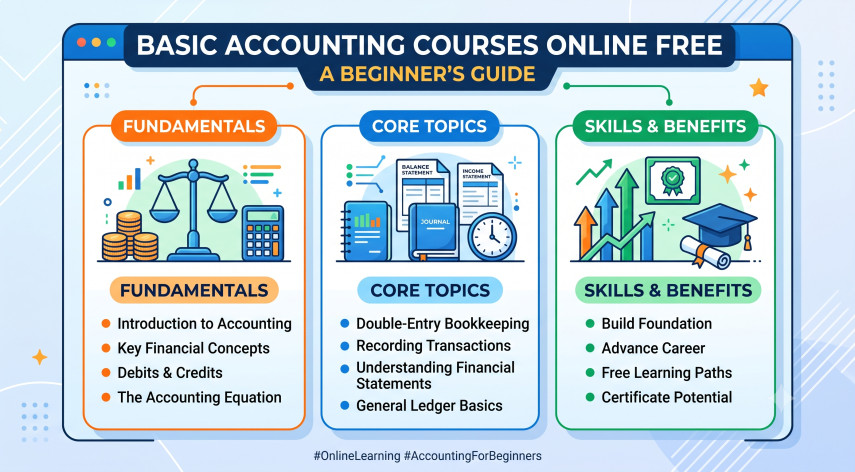
Learning accounting doesn’t have to start with tuition. Plenty of people build a solid foundation using free online lessons before deciding whether to go further with a paid course, certification, or degree.
The tricky part isn’t finding free accounting content — it’s figuring out which free courses are actually worth your time, and which ones quietly charge for the certificate at the end. This Queknow guide walks through what free basic accounting courses typically cover, how to tell real value from thin content, and how long it realistically takes to get comfortable with the basics. If you want a broader look at free options beyond the basics, see our companion guide to accounting courses online free
Can You Learn Basic Accounting Online for Free?
Basic accounting courses online free are introductory lessons covering fundamentals like debits and credits, journal entries, and financial statements, offered at no cost by various platforms and educators. Depth and quality vary widely, and not every free course includes a free certificate — some charge separately for verified completion credentials.
Free accounting education generally comes from a mix of sources:
- University-affiliated platforms offering free audit access to introductory courses
- Nonprofit and educational organizations publishing open lesson content
- Individual accounting professionals and educators sharing free video lessons
- Accounting software companies offering basic training tied to their tools
- Community college open courseware, where available
Some of these resources are thorough and well-structured. Others are short overviews designed mainly to lead into a paid upgrade. Knowing the difference before you invest time matters.
What Do Basic Accounting Courses Usually Teach?
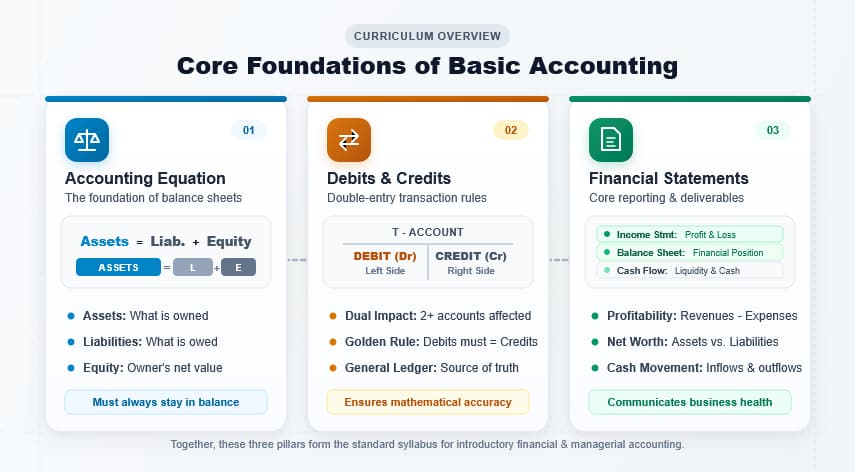
Most beginner-focused courses, free or paid, cover a similar core set of topics:
- Accounting principles — the basic rules guiding how transactions are recorded
- The accounting equation — assets = liabilities + equity
- Debits and credits — how the double-entry system works
- Journal entries — recording individual transactions
- Ledgers — organizing entries by account
- Trial balance — checking that debits and credits match
- Financial statements — the income statement, balance sheet, and cash flow statement
- Basic bookkeeping — day-to-day recording of income and expenses
- Reconciliation — comparing records against bank statements to catch errors
- Basic financial reporting — summarizing financial activity in a usable format
A genuinely useful basic course should cover most of these areas with at least some practice exercises, not just video explanations.
Where Can You Find Basic Accounting Courses Online for Free?
Rather than chasing a specific list of course names — which changes constantly — it helps to understand where legitimate free accounting education tends to come from:
- University-affiliated learning platforms — often allow free “audit” access to introductory courses, without the credit or degree pathway
- Nonprofit and educational organizations — sometimes publish free curricula focused on financial literacy or small-business accounting
- Accounting software providers — frequently offer free basic training tied to their own tools, which can double as general accounting education
- Independent educators and accounting professionals — publish free video series and lessons, varying widely in depth and structure
- Community colleges — some offer open courseware or free introductory modules, separate from their paid, credit-bearing programs
Whichever source you choose, check the provider’s current page directly rather than relying on outdated third-party lists, since course availability and pricing structures change over time.
Are There Free Accounting Courses With Certificates?
Some free accounting courses include a certificate, but many separate free course access from a paid certificate. It’s worth understanding these differences clearly before assuming “free” means the whole experience, credential included, costs nothing.
Common models include:
- Completely free course — no cost for content or certificate
- Free course with optional paid certificate — the lessons are free; a verified certificate costs extra
- Free audit access — free access to material without graded assignments or a certificate
- Free trial — free for a limited time, then a paid subscription
- Financial-aid-supported access — free or reduced cost through an application process
- Certificate of completion vs. professional certification — a completion certificate shows you finished the course; it is not the same as a recognized professional accounting certification
Do not assume that a certificate from a free course carries professional recognition unless the provider clearly states its accreditation or industry standing. A completion certificate is a useful personal record, but it isn’t equivalent to a credential from a certifying body or accredited institution.
Is a Free Bookkeeping Course the Same as a Basic Accounting Course?
Not exactly. Bookkeeping and accounting overlap significantly, but they aren’t identical.
Bookkeeping focuses on the practical, day-to-day recording of financial transactions — entering invoices, tracking expenses, reconciling bank statements, and keeping records organized. Accounting includes bookkeeping but extends further into interpreting financial data, preparing financial statements, and analyzing what the numbers mean for decision-making.
A basic bookkeeping course online free typically emphasizes:
- Recording transactions accurately
- Using accounting software for day-to-day entries
- Reconciling accounts
- Organizing financial records
- Basic invoicing and expense tracking
A basic accounting course usually covers those same bookkeeping tasks, plus a broader introduction to financial statements and accounting principles. If your goal is specifically to manage books for a small business or job, a bookkeeping-focused course may get you there faster than a broader accounting course.
How Long Does It Take to Learn Basic Accounting?
There’s no single answer, since the timeline depends on your prior experience, how much time you study each week, and what level of proficiency you’re aiming for.
It helps to separate a few different goals:
- Understanding basic concepts — Many beginners grasp core terminology and the accounting equation within a few days to a couple of weeks of regular study.
- Performing simple bookkeeping tasks — Comfortably recording transactions and reconciling accounts often takes several weeks of consistent practice.
- Becoming comfortable with financial statements — Reading and understanding an income statement or balance sheet typically takes longer, often a month or more of applied practice.
- Developing job-ready bookkeeping or accounting skills — This usually requires ongoing practice over several months, often alongside real transactions or structured coursework.
- Becoming professionally qualified — Formal qualifications, such as a degree or professional certification, involve a much longer timeline, often spanning months to years depending on the credential.
A free course can realistically help with the first two or three stages. It’s not designed to carry you all the way to professional qualification, and no responsible course should claim otherwise.
What Should You Look for in a Free Accounting Course?
Use this checklist before committing time to any course:
- Syllabus — Does it clearly outline what topics are covered and in what order?
- Instructor or institution credibility — Is the source clearly identified, with relevant background?
- Level of difficulty — Is it genuinely designed for beginners, or does it assume prior knowledge?
- Practical exercises — Can you apply concepts through practice problems, not just watch videos?
- Assessments — Are there quizzes or checks to confirm understanding?
- Certificate availability — Is a certificate offered, and is it actually free or a paid add-on?
- Certificate cost — If a certificate is available, what does it cost, and is that clearly disclosed upfront?
- Course duration — How long is the course expected to take?
- Updated content — Has the material been reviewed or updated recently?
- Software training — Does the course include hands-on practice with accounting tools?
- Student support — Is there any way to ask questions or get help if you’re stuck?
- Accessibility — Can you access the material on your schedule, and for how long?
Running through this list before enrolling helps you avoid spending hours on a course that turns out to be too shallow, or discovering a certificate fee only at the very end.
Free Accounting Courses vs Paid Courses
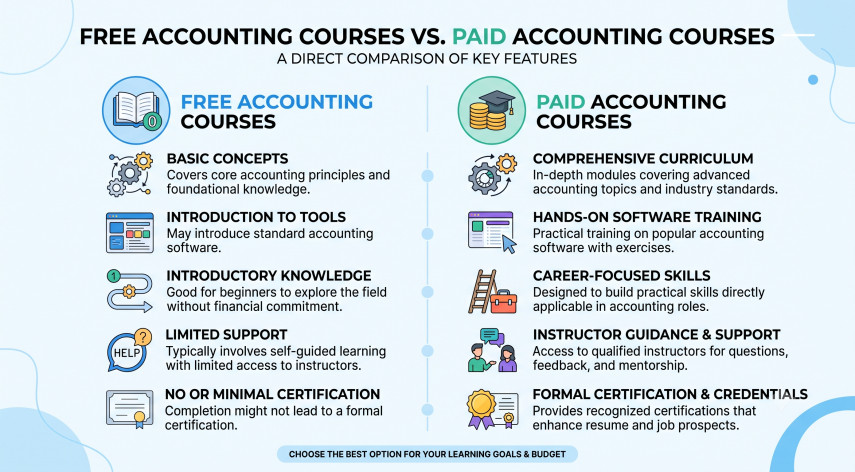
| Factor | Free Courses | Paid Courses |
|---|---|---|
| Cost | No cost | Ranges from low-cost to significant |
| Structure | Often less structured | Typically more structured |
| Instructor support | Limited or none | Often includes instructor access |
| Assessments | Basic or none | More structured testing and feedback |
| Certificates | Sometimes free, often a paid add-on | More likely to include a verified certificate |
| Practical exercises | Limited | Often more extensive |
| Software training | Varies | More likely to be included |
| Career relevance | Useful for foundational knowledge | More likely to align with employer expectations |
Free courses aren’t automatically worse, and paid courses aren’t automatically better. A free course can be genuinely sufficient if your goal is foundational knowledge or a quick skills refresher. A paid course tends to make more sense when you need structured feedback, deeper software practice, or a certificate that’s actually included in the price. If you decide to go the paid route, Queknow’s guide on how much an online accounting course costs explains what actually drives that price.
Can a Free Accounting Course Help You Get a Job?
It depends on what “help” means in your specific situation.
A free course can help you:
- Understand core accounting terminology and concepts
- Build enough bookkeeping skill to manage basic financial tasks, including getting familiar with tools like the ones covered in Queknow’s CPA accounting software guide
- Decide whether accounting or bookkeeping interests you as a career path
- Prepare for further, more structured education
A free course is less likely to, on its own:
- Meet a specific employer’s stated education or certification requirements
- Substitute for a professional accounting credential
- Guarantee an interview or job offer
- Replace hands-on experience that many employers expect
Completing a course is different from earning a certificate, and earning a certificate is different from becoming professionally qualified. Employers vary widely in what they require, so it’s worth checking specific job postings in your area to understand what level of credential or experience is actually expected before assuming a free course will be enough.
A Beginner’s Learning Path for Accounting
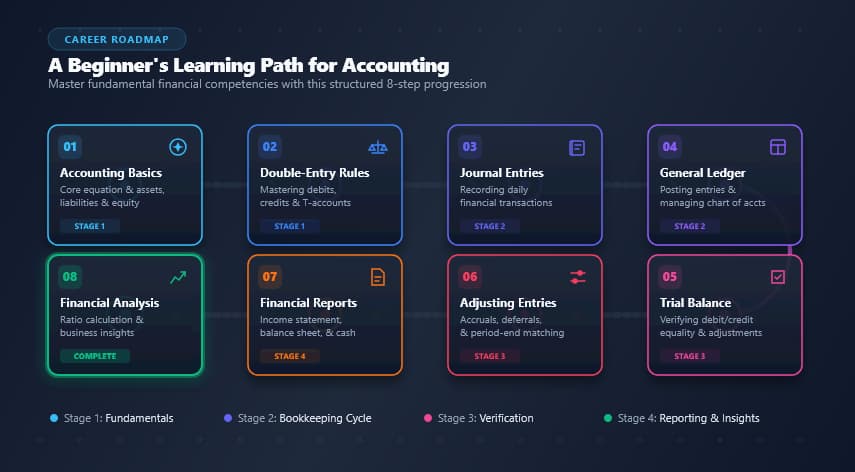
For someone starting from zero, a logical progression looks like this:
- Learn accounting terminology. Get comfortable with terms like assets, liabilities, equity, revenue, and expenses.
- Understand the accounting equation. This is the foundation everything else builds on.
- Practice debits and credits. Work through simple examples until the logic feels routine.
- Record journal entries. Practice recording basic transactions step by step.
- Learn the ledger and trial balance. Understand how individual entries roll up into totals.
- Study financial statements. Start with the income statement and balance sheet.
- Practice basic bookkeeping. Apply what you’ve learned to ongoing recordkeeping.
- Practice reconciliation. Learn to compare your records against bank statements and resolve discrepancies.
This sequence assumes steady practice rather than a single weekend course. Most beginners need several weeks of regular study before the fundamentals feel solid. Once you’re through these steps, Queknow’s guide to AI accounting courses is a reasonable next stop if you want to see how AI tools now fit into everyday accounting work.
Common Mistakes Beginners Make When Learning Accounting
- Skipping debits and credits. Jumping straight to financial statements without this foundation usually causes confusion later.
- Assuming “free” always means a free certificate. Many providers charge separately for a verified credential.
- Choosing a course based only on price. A free course isn’t automatically worse, but it’s also not automatically sufficient for every goal.
- Not practicing with real numbers. Watching lessons without working through exercises rarely builds lasting skill.
- Overestimating what a short course provides. A few hours of free content won’t produce job-ready or professional-level skills on its own.
- Ignoring how current the material is. Accounting content tied to software or tax-adjacent topics can become outdated quickly.
Frequently Asked Questions
Can I learn basic accounting online for free?
Yes. Many platforms, educators, and organizations offer free introductory accounting lessons covering topics like debits and credits, journal entries, and financial statements. Quality and depth vary, so it’s worth checking a course’s syllabus and format before committing your time.
What is the best free online accounting course for beginners?
There isn’t one universally “best” course, since quality depends on your specific goals and learning style. Look for a course with a clear syllabus, practical exercises, and coverage of core fundamentals like the accounting equation and financial statements before deciding it’s worthwhile.
Are there free accounting courses that offer certificates?
Some do, but many separate free course access from a paid certificate. Check whether the certificate is genuinely included at no cost or offered as a paid add-on, and confirm what the certificate actually represents before assuming it carries professional recognition.
Can I learn bookkeeping for free online?
Yes, many free courses focus specifically on bookkeeping tasks like recording transactions, reconciling accounts, and using accounting software. These courses tend to be more practical and narrowly focused than broader accounting courses covering financial statements and reporting.
How long does it take to learn basic accounting?
Timelines vary based on prior experience and study time. Many beginners grasp core concepts within a few weeks of consistent study, while becoming comfortable with financial statements or job-ready bookkeeping skills typically takes longer, often a month or more of applied practice.
Is a free accounting certificate worth it?
It depends on what you need the certificate for. A free completion certificate can be a useful personal record of your learning, but it typically isn’t equivalent to a recognized professional certification. Check the provider’s stated accreditation before assuming it holds formal weight with employers.
Can I learn accounting without a degree?
Yes, you can learn accounting fundamentals and even build practical bookkeeping skills without a degree. However, certain accounting roles and professional credentials, including CPA licensure, typically require formal education and examination requirements that free courses don’t fulfill on their own.
Is bookkeeping easier to learn than accounting?
Bookkeeping is generally more narrowly focused on recording transactions, which can make it feel more approachable initially than full accounting, which extends into financial analysis and reporting. That said, both build on the same foundational concepts, like debits and credits.
What should I learn first in accounting?
Most learners benefit from starting with basic terminology and the accounting equation, then moving into debits and credits, journal entries, and the ledger before tackling financial statements. This order tends to make each new concept easier to understand.
Can a free accounting course help me start a bookkeeping career?
A free course can help you build foundational skills and decide whether bookkeeping interests you, but most bookkeeping roles also value practical experience or additional training. Check local job postings to understand what specific skills or credentials employers in your area typically expect.
Conclusion
Learning basic accounting online for free is genuinely possible, and it’s a reasonable starting point whether you’re exploring the subject, managing your own small business finances, or considering further education. The key is understanding what “free” actually includes — course access, a certificate, or both — and matching your course choice to your actual goal.
Start with the fundamentals, practice consistently, and use the checklist in this guide before committing time to any specific course. Once you’ve built a solid foundation, you’ll be in a much better position to decide whether a paid course, certification, or further education makes sense for where you want to go next.

Mike Farrier is a seasoned technology journalist, digital trends researcher, and Senior Editor at Queknow. With over a decade of hands-on experience spanning web architecture, emerging tech, digital consumer products, and data-driven market insights, Mike bridges the gap between complex topics and actionable knowledge. He leads the editorial team to deliver rigorously fact-checked, up-to-date guides and comprehensive analysis across digital lifestyle, enterprise technology, and online business ecosystems. When not analyzing industry shifts, Mike actively tests consumer software and contributes to tech forums.
Recommended For You

Freelancing comes with a version of bookkeeping most employees never have to think about: tracking your own income, categorizing your
A chat window with a typing indicator used to be the standard for AI-powered customer interaction. Now, a growing number

An auction catalog tells you far more than what is for sale. If you know how to read it, it